
Consumer Unit Replacement in Nottingham — Request an Assessment
Plan a fuse-box or consumer-unit replacement around the actual circuits. Request an assessment, a defined equipment specification and a clear installation quotation.
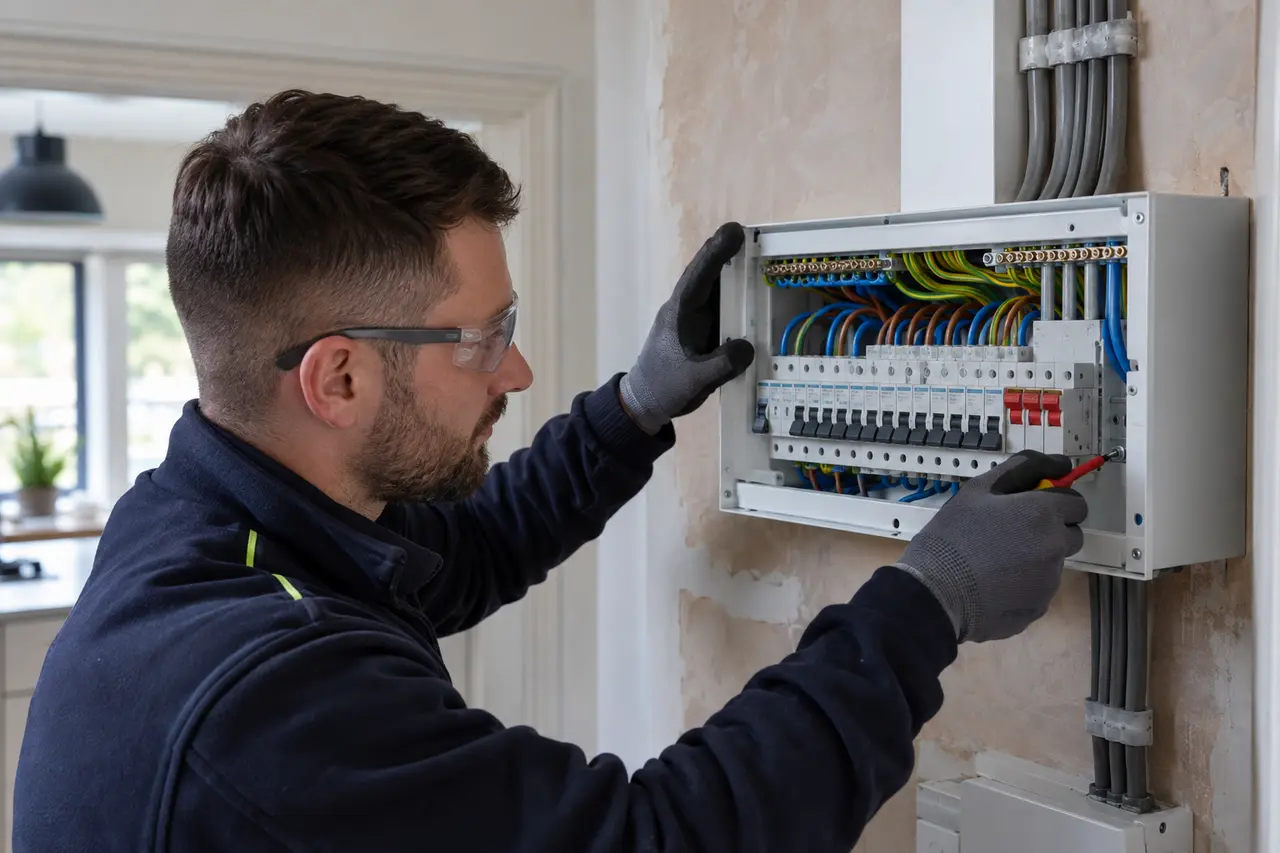 Scope checked before work begins
Request a consumer-unit replacement assessment in Nottingham
Ask Electrician24 to assess a consumer-unit replacement, fuse-box upgrade or circuit-protection alteration at your Nottingham property. Start with the reason for the proposed work: an inspection finding, a damaged enclosure, a planned additional circuit or a refurbishment. That reason determines what the quotation needs to address. Buying a larger board first can leave the important questions about the existing circuits and the intended installation unanswered.
A consumer unit distributes electricity to the property's circuits and houses their protective equipment. Replacing it changes that part of the installation; it does not replace the cables serving every room. The proposal should explain which existing circuits will be connected, what assessment supports that decision and how defects discovered outside the board are handled. Treat the circuit work and the enclosure purchase as related but separately identifiable parts of the project.
For an enquiry, send the postcode, a photograph of the closed board if it is safely accessible, and any relevant report. Do not remove the cover to count connections or read internal markings. Tell the booking contact about separate boards, outbuilding supplies and installed generation or storage systems. A quotation based on an incomplete picture of the installation may require revision once those arrangements become apparent.
This page concerns planned consumer-unit work. If the equipment is smoking, sparking or associated with an active dangerous condition, use the appropriate emergency response rather than waiting for an upgrade quotation. The emergency-electrician page distinguishes urgent property faults from fire and network emergencies. A consumer-unit replacement can be considered after the immediate situation has been assessed; it should not be assumed to be the required remedy from a symptom alone.
Establish why the board is being changed
An existing inspection has identified an issue
Provide the relevant EICR observation and its supporting description, including the report's installation details and limitations. A note about protective equipment is more useful than a cropped image showing only an unsatisfactory result. The proposed replacement needs to respond to the actual finding. Ask the quoting electrician to identify which observations the work will address and which relate to other parts of the property.
Where an agent or another electrician has summarised the report verbally, retain the original wording alongside that summary. “New fuse box required” may leave out an associated circuit defect or an access limitation. The electrical testing service is the relevant route when the condition itself still needs establishing. Replacing distribution equipment should follow an understood scope rather than serve as a substitute for reading the evidence already available.
A new appliance or circuit is planned
Explain the proposed load and installation, not only the number of unused spaces you would like. An EV charger, workshop supply or major kitchen alteration may require decisions beyond fitting another device into a board. The electrician needs the equipment information and the intended cable route as well as details of the existing supply. Available physical space is one part of planning, not approval of the complete addition.
Tell the contractor whether the additional equipment has been purchased and whether another installer is responsible for it. If a charge-point company will connect later, clarify what information they require from the consumer-unit project. Avoid two quotations that each assume the other contractor has assessed supply capacity or provided the necessary circuit. Separate ownership of tasks is workable when the interface between those tasks is explicit.
The existing equipment looks dated
Appearance alone does not establish whether a consumer unit is unsafe or which alteration is justified. Electrical Safety First notes that older equipment does not necessarily require replacement simply because of its age or arrangement; assessment of condition matters. Its home-buying electrical advice explains that distinction. Ask what evidence supports the proposed work and what practical benefit the specified change will provide at your property.
For a renovation, an owner may choose to update equipment while access is easier even when the decision is not driven by an immediate fault. State that objective openly so that necessary remedial items can be separated from elective improvements. If a property transaction is involved, tell the electrician whether you need an assessment, a firm remedial quotation or completed work before a particular date. Those are different deliverables.
Define the installation boundary before comparing quotations
Identify every board included in the instruction
A property may have a main consumer unit and a separate distribution arrangement for an extension, garage or other area. List the equipment you already know about without opening it. Ask the quotation to identify the particular board being replaced and explain the position of retained boards in the proposed work. “Consumer-unit upgrade” is not a sufficiently precise description when more than one assembly exists at the address.
Record whether the quoted circuit count is based on a site assessment or information supplied remotely. Labels can be incomplete or reflect an earlier layout. The electrician should establish the circuits that will actually be connected, while the owner explains how the spaces are used. A later discovery that two labels do not represent two independent circuits should lead to a clear scope discussion, not an unexplained change to the invoice.
Separate private and shared installations
In a flat or converted building, identify whether the work concerns the occupier's installation, communal services or another separately managed supply. The freeholder or managing agent may control access to electrical equipment outside the dwelling. A flat owner should not assume that ownership of the interior grants authority to alter a shared distribution arrangement. Describe the management structure and obtain the appropriate permissions for the proposed work.
For a rented house, name the person instructing the project and the person arranging tenant access. If the quote is being obtained through an agent, ask that the owner receive the actual specification rather than only a total price. An explanation of retained circuits, discovered-defect arrangements and documentation is important to whoever accepts the work. Keep the address and any unit number consistent across the instruction, invoice and final records.
Assess retained circuits before committing to connection
Changing protective equipment can bring existing wiring problems into focus. An assessment before replacement helps establish whether the planned arrangement can be connected as proposed. Electrical Safety First's consumer-unit replacement guidance specifically addresses hazards that can arise from an existing installation. Ask the electrician what preliminary investigation is included, how findings will be communicated and which findings could change the work required.
The customer's role is to provide access, records and a history of known problems. Tell the assessor about a circuit that intermittently disconnects, sockets that have stopped working or alterations that were never documented. Do not conceal an intermittent symptom because the intention is to replace the board anyway. A new assembly does not remove the need to investigate a defect elsewhere, and advance information may prevent avoidable disruption during the installation appointment.
Agree how unexpected findings are authorised
Ask the quotation to distinguish the planned replacement from additional circuit repairs. A useful agreement explains how the electrician will describe a newly identified defect, propose the associated work and obtain approval. If you have a spending limit, set it before the installation date and identify a contact who can respond. The limit should be realistic about the possibility that an affected circuit cannot be returned to use pending remedial work.
Where inspection is restricted, record the practical reason. A room may be locked, a fixed item may obstruct access or another occupier may be unavailable. A limitation is information about what could not be assessed, not confirmation that the inaccessible part is acceptable. Discuss whether access needs to be resolved before the replacement appointment or whether a staged instruction is more appropriate. Avoid accepting an apparently complete scope that quietly depends on unavailable access.

Understand the protection specification you are purchasing
Ask for a defined device arrangement
The quotation should describe the proposed protective arrangement clearly enough to distinguish it from a different offer. An RCD responds to certain earth-leakage conditions; an RCBO combines residual-current and overcurrent protection for an individual circuit. The IET's consumer-unit guidance explains the different functions of the equipment. The electrician must select devices appropriate to the installation rather than offer a universal shopping list.
For the customer, the useful discussion concerns what the design means for the circuits and the property's use. Ask which circuits are covered by each device, how the circuit schedule will identify them and what instructions will be provided at handover. Avoid assuming that two quotations are equivalent because each uses the phrase “modern fuse box”. The manufacturer's system, device arrangement and associated circuit work all belong in the specification.
Discuss additional protective features in context
If surge protection, arc-fault detection or another feature is proposed, ask the designer to explain its role and the basis for including it in this installation. The answer should relate to the applicable requirements and assessment rather than a blanket claim that every property must buy the same package. This page does not assign a particular device selection to an unseen property or substitute for an electrician's design responsibility.
Keep equipment compatibility within the contractor's agreed responsibility. Components that physically fit are not necessarily interchangeable across a manufacturer's assembly. If you already own a consumer unit or devices, disclose the exact product information before a quote is accepted and ask whether the contractor is willing to specify them. Do not purchase mixed parts on the assumption that labour-only installation will be straightforward or cheaper once compatibility and warranty arrangements are considered.
Survey board position, enclosure access and cable routes
Keeping the existing position
Remaining in the same location does not guarantee that a replacement is a simple like-for-like exchange. The new assembly's dimensions, cable entries and installation requirements need assessing. Provide the surrounding cupboard or wall dimensions if requested, but let the electrician determine the equipment position. A tight decorative enclosure, shelves or stored items can make both installation and future access more difficult than a close-up photograph of the board suggests.
Explain any planned joinery before the electrician commits to the layout. A new cupboard should not be designed around the assumption that access for operation, inspection and maintenance can be reduced to the size of a small door. Coordinate the joiner and electrician while drawings can still change. Identify who is responsible for removing or altering existing cabinetry and whether that work is included in the electrical quotation or supplied by another trade.
Moving the consumer unit
Relocation needs a specific proposal because the connection routes may change. Show the electrician the intended destination, the intervening building fabric and any finishes you want retained. Ask what additional investigation or building access is required before the price can be fixed. The preferred aesthetic position may not be the most practical installation position, and the electrical design must take precedence over an unassessed sketch.
If the project involves the meter or incoming network equipment, identify the third party responsible for that equipment and the process they require. Do not assume that a consumer-unit contractor can move it as part of a general board-replacement price. Keep appointments and responsibilities separate where different organisations are involved. A plan that depends on another party's work should name that dependency before either contractor is expected to attend.
Plan isolation and the period without power
Ask how the supply will be isolated for the replacement and whether any arrangement with a supplier or network operator is required. The electrician should resolve that method professionally. Customers should not remove supply fuses, break seals or open incoming equipment to help prepare the job. If an authorised third-party appointment is necessary, clarify who books it and whether its timing affects the proposed installation date.
Make an inventory of equipment that needs attention before the planned interruption: computers, heating controls, access systems and any other important powered function. Share the practical requirements with the electrician without sending unnecessary personal information. An occupied property may need a different appointment plan from an empty refurbishment. A tentative duration should not be treated as a guarantee that every circuit will be back in service at a particular minute.
Work, deliveries and other trades on the installation day
Tell other trades that power may be unavailable so they do not arrive expecting to operate equipment throughout the work. Coordinate deliveries that require a powered gate, lift or shutter. For a home office, arrange an alternative working plan rather than assuming one socket will remain available. The electrical contractor needs to control the work area and should not be put under pressure to supply an improvised workaround for avoidable scheduling conflicts.
Clarify whether somebody must remain at the premises and when decisions may be needed. If the owner leaves, the electrician still needs an authorised route for discussing discovered defects. Provide a contact who can understand and approve the work, not merely pass on messages. At the end of the planned interruption, allow time for testing, documentation and explanation rather than arranging an immediate event that depends on the installation being ready.
Compare the full project price
Assessment, equipment and installation labour
A meaningful quotation identifies any preliminary assessment, the equipment specification and the installation work. Ask whether a survey charge is separate or credited against a later instruction. Establish which assumptions support the price, including the number of circuits, access conditions and whether the board remains in the existing position. A lower headline amount can reflect a narrower scope rather than a better price for the same work.
Check how materials are supplied and who is responsible if an item is unsuitable or unavailable. If the customer wants a specific manufacturer, state that before acceptance and ask the electrician to confirm a suitable assembly. Avoid treating a product advertised online as proof that it is appropriate for the property. The quotation should tie the supplied equipment to the assessed installation and explain any permitted substitutions before work starts.
Circuit repairs and associated building work
Identify which known remedial items are included and how unknown defects will be handled. Ask for references to existing report observations where relevant. Separate electrical work from plaster repairs, painting, joinery and decoration so that the project budget reflects the completed result you expect. If a route alteration requires another trade, establish who instructs that trade and which appointment must happen first.
Use written electrical estimates to compare the treatment of additional labour, return visits and applicable tax. Ask for a clear payment schedule and the documents expected at completion. Do not judge value solely by the enclosure's purchase price; the assessment, installation, verification and records are material parts of the service. Equally, an expensive specification needs an explanation of its relevance, not just a longer list of branded components.
Coordinate a replacement with a larger property project
Rewiring, extensions and kitchen alterations
When a rewire is also proposed, align the consumer-unit specification with the agreed circuit plan. Fitting a board before the design is settled may create avoidable changes later. The owner should provide the proposed room layout and equipment schedule, while the electrical contractor identifies what can be retained and what needs replacing. Record the boundary between any early enabling work and the final installation.
For a kitchen project, explain the intended appliances and their locations before the board specification is finalised. A cabinet layout alone may not state the electrical requirements. Coordinate the kitchen supplier, installer and electrician so that none assumes the others have specified the circuits. If some appliances will be installed later, distinguish a documented provision for future work from a completed, commissioned circuit ready for immediate use.
EV charging, garden supplies and stored energy
An EV charging project needs to be considered as a complete installation rather than merely an extra way in a consumer unit. Provide the intended equipment and parking arrangement to the responsible designer. Where a separate charge-point installer is involved, ask what information they need and who is assessing the supply. A shared understanding of the project prevents a new board being sold as automatic approval for the charger.
For a garden or outbuilding supply, describe the intended use and the route between buildings. If solar generation, storage or a backup system is already installed, provide its records and service contact. Those systems can affect the project arrangements and must not be omitted from the enquiry. The consumer-unit quote should state its relationship with specialist equipment rather than absorb unspecified alterations under the vague heading of future-proofing.
Commissioning and the documents to retain
Record the work that was actually completed
The completion information should identify the installed equipment, the circuits included and any changes from the accepted quotation. Ask for a clear circuit schedule and the relevant instructions for the supplied devices. If something was left disconnected or a planned item was deferred, that needs to appear in the handover. The customer's understanding should match the electrician's record instead of relying on the original proposal after the work has changed.
Replacing a domestic consumer unit in England is notifiable work under the building-control framework. Confirm the notification route before instruction and establish who supplies the electrical installation and building-regulations documentation. These records serve different purposes. The government's Approved Document P describes the framework. Check the contractor's claimed registration independently rather than assume that a website listing or a quotation heading establishes scheme membership.
Keep the new records alongside the existing history
Store the replacement documents with the previous EICR and certificates for retained circuits. The new paperwork does not turn the entire older installation into newly installed wiring. A later inspector or purchaser needs to understand both the new work and the earlier history. Keep an electronic copy where possible and make sure that the property address, work description and dates identify the job accurately.
For a rented property, arrange for the landlord or managing agent to retain the relevant records rather than leaving the only copy with a temporary occupier. If a third party requested the work, check which documents they require and submit the actual records. Do not describe a replacement as satisfying every outstanding property requirement unless the responsible party has reviewed the scope and evidence. An electrical installation project and a tenancy administration process are connected but not identical.
Use the handover to understand the installed arrangement
Ask the electrician to explain the circuit labels, the supplied operating instructions and the procedure for the user checks recommended by the equipment manufacturer. The explanation should refer to the actual assembly installed. You should not need to memorise a generic internet diagram or infer the function of devices from their position. Keep the instructions accessible to the people responsible for the property after the appointment.
If a protective device operates later, the circumstances still need assessing; a recently replaced board is not proof that every future incident originates inside it. Note which labelled circuit is affected and contact the appropriate contractor with the job details. Do not replace devices yourself or assume that fitting a different rating will prevent the symptom. The installation's protection is part of its design, not a user-adjustable response to inconvenience.
Clarify the route for reporting a suspected defect in the new work, including the contact details and any written workmanship terms supplied. Keep product warranties distinct from labour arrangements and from unrelated faults in retained circuits. If the property changes hands, pass on the instructions and installation documents. The value of an accurately completed project continues through an understandable record of what was installed, assessed and left for future attention.
Confirm responsibility for the design and final verification
Before instructing the replacement, establish which business is contracting with you and who takes responsibility for the specified design, installation and verification. If a surveyor, installer and testing electrician are different people, the project still needs a coherent handover between them. Ask whom you should contact if the installation differs from the quotation. A subcontracting arrangement should not leave the customer trying to decide which party owns a technical decision or an unresolved completion item.
Check a claimed registration using the relevant scheme's current public register and the contractor's exact business details. Do not rely on a copied badge or assume that a familiar trading name matches the registered entity. The qualifications and certification page helps frame that enquiry. Keep the accepted quote and the registration information with the job record, while recognising that verification of a contractor's status does not replace assessment of the specific installation design.
If you commission an independent review after completion, supply the reviewer with the accepted scope, any variations and the actual installation documents. A reviewer needs to understand what was replaced and what was deliberately retained. Where a question is raised, ask for the observation to be tied to the relevant part of the work and seek a response from the responsible contractor. This creates a usable record for resolving a concern instead of relying on conflicting informal opinions about a photograph.
Send a quotation brief that identifies the actual project
Your first message can state the address, why replacement is being considered and whether the property is occupied. Add the relevant EICR pages, a safely taken external photograph and a list of known additional boards or specialist energy equipment. Explain any proposed relocation and the dates of associated building work. These details support the assessment; they do not commit the contractor to a remote fixed price.
State who can authorise the work and whether the quote needs to go through a landlord, agent or project manager. If you are comparing offers, request a specification that separates the board replacement from circuit remedials and building finishes. Tell the contractor about requirements that affect scheduling, such as controlled access or a third-party isolation appointment. A useful quotation brief allows those dependencies to be discussed before an installation date is accepted.
Use the enquiry form below to prepare the main details, or contact Electrician24 directly to arrange the assessment. Confirmation should identify the property, the next appointment and whether it is a survey or installation visit. The Nottingham area listing does not determine the scope of your circuits or the suitability of a board. Those decisions belong to the assessment of the actual premises and the written proposal that follows it.
Frequently asked questions about consumer-unit projects
Does replacing a fuse box also replace the house wiring?
No. The replacement concerns the distribution assembly and the work expressly included with it. Existing cables and accessories may remain, subject to the electrician's assessment and necessary remedial work. If you want circuits renewed, specify that as part of a rewiring instruction. Keep the quotation precise about retained and replaced parts so that the final certificate and invoice are not later misunderstood as evidence that every cable in the house was renewed during the board project.
Can I obtain a firm replacement quote from one photograph?
A photograph can help the initial discussion but cannot show the condition of every connected circuit or resolve all access and isolation questions. Ask whether a quoted amount is provisional and what assessment is required before it becomes a firm scope. Provide relevant records and known defects rather than relying on the image alone. The useful outcome is a price based on stated findings and assumptions, with an agreed procedure for additional work if new information emerges.
Do spare ways mean my existing supply can support more equipment?
Spare space in the enclosure does not establish capacity or suitability for a proposed load. The electrician must consider the equipment, circuits and supply arrangement as part of the design. Describe the actual addition, including an EV charger or outbuilding use, instead of asking only for more spaces. A replacement board can form part of that project, but purchasing one with a larger physical layout does not by itself settle the electrical requirements of the new equipment.
Can the contractor reuse protective devices from my old board?
That decision belongs in the equipment specification and compatibility assessment. Do not assume that devices can be transferred because they appear undamaged or have a similar physical shape. Tell the contractor what you hope to retain and ask them to explain whether it is appropriate within the proposed assembly. The quotation should identify supplied and retained equipment clearly, including who accepts responsibility for its selection, rather than leaving reuse as an informal expectation discussed only on installation day.
What happens if testing identifies a fault in a retained circuit?
The contractor should explain the finding and its implications for the agreed work. Refer to the procedure for additional authorisation in the quotation: what repair is proposed, how it is charged and whether the circuit can be included before it is completed. You may need to approve extra investigation or leave an affected part unavailable. Replacing the board should not be presented as automatically correcting a defect elsewhere, and reconnecting every circuit should not be guaranteed regardless of its condition.
Can I keep the old board until a later renovation stage?
Ask the electrician to assess that sequence against the condition of the existing installation and the planned work. A staged renovation needs a clear boundary for each phase and a decision about which equipment supports it. The answer cannot be based solely on the age or appearance of the enclosure. Explain the timetable and what will change between stages so that any interim arrangement is deliberately assessed rather than becoming an unplanned consequence of delaying the final project.
Is a consumer-unit replacement certificate the same as an EICR?
The records address different tasks. The replacement requires documentation for the installation work, while an EICR reports on the condition of an existing installation within its inspection scope. Ask exactly which records the quotation includes and why a third party may require an additional report. Do not use the presence of a new board as a substitute for the wider inspection someone has requested, or assume that a previous EICR certifies a replacement completed after that inspection.
Who deals with building-control notification for a Nottingham home?
Confirm the applicable notification route with the contractor before accepting the work. A suitably registered installer may use their scheme, while another route can involve building control. Ask for evidence of the registration being relied upon and confirmation of the resulting documents and any separate charges. Avoid treating a general claim of qualification as proof of a particular notification arrangement. Responsibility for the process should be explicit in the instruction rather than left for the owner to discover after installation.
Is the electricity meter included in a fuse-box replacement?
Usually the meter and network-side equipment belong to separate responsibilities, so do not assume they are included in the consumer-unit contract. If the proposed position or isolation arrangement affects that equipment, ask which organisation must be involved and who arranges its attendance. Keep their work and any charges visible in the programme. A board replacement quotation should not quietly rely on another party completing an unbooked alteration before the electrician can start.
How should I compare an RCBO quotation with another board proposal?
Ask each contractor to explain the circuit arrangement, the specified devices and the reason for their design. Compare the assessment and remedial allowances as well as the hardware. The useful distinction is what the complete proposal delivers for your installation, not just whether a particular acronym appears in the title. If the offers rely on different assumptions about retained circuits, request clarification before treating their prices as alternatives for an identical scope.
Should surge protection be included automatically?
Ask the designer to state the applicable requirement and assessment for the property and proposed work. If protection is included, the quotation should identify it and the handover should explain the relevant equipment instructions. This page does not make a universal selection for every installation. A customer comparing quotations should seek the reasoning behind each design, especially where one offer includes a feature and another excludes it without explaining how that decision was reached.
Can the consumer unit be hidden inside new kitchen cabinetry?
Discuss the proposed enclosure with the electrician before the cabinet is manufactured or fitted. Operation, inspection and maintenance access remain important, and the equipment's installation requirements need accommodating. Provide dimensions and drawings showing the surrounding storage and doors. Ask the joiner and electrician to agree their respective work. A cosmetic cover should not be designed on the assumption that the board will never need access after installation or that every available cupboard position is suitable.
Will every appliance continue working during the replacement?
Plan for a power interruption and identify equipment that needs special arrangements beforehand. The contractor must establish the isolation and work sequence, and a promise of uninterrupted use should not be inferred from a short estimated installation time. Arrange an alternative for home working and coordinate any necessary shutdown of other equipment. If continuity is critical, explain the requirement at survey stage so that the responsible people can determine a suitable plan instead of improvising on the day.
What should I tell the electrician about solar panels or battery storage?
Provide the equipment details, available installation records and the contact for its installer or maintenance provider. Explain whether the consumer-unit project is intended to alter that system or retain it unchanged. The presence of generation or storage must be understood when planning the work and its isolation. Do not attempt to demonstrate or operate unfamiliar isolation equipment yourself; the information is for the contractor to establish the appropriate method and any specialist coordination needed.
Can a landlord arrange replacement while tenants are away?
That can be considered if access, authority and the property's practical needs are properly arranged. Agree how the occupants will be informed, what equipment may be affected and who receives the handover before they return. The landlord should remain available for decisions about unexpected circuit findings. An empty appointment window does not remove the need to communicate restrictions or explain the new board's instructions to the people who use the installation every day.
Does a board upgrade include plastering and repainting?
Only where those tasks are expressly included. Ask the quotation to describe likely disturbance and distinguish the electrical installation from making good the surrounding wall, cupboard or decorative finishes. Relocation can create additional building work compared with retaining the existing position. If another trade is responsible, establish the sequence and the point at which finishes can be completed. The expected appearance at handover should be agreed rather than inferred from the phrase “complete installation”.
Can I supply the board to reduce the quotation?
Discuss that before buying anything. The electrician needs to accept the equipment as appropriate for the design, confirm compatibility and explain how supply and warranty responsibilities will work. A cheap enclosure without the correct devices or supporting components may not represent a saving. If the contractor declines customer-supplied equipment, understand that before committing money. A written specification is a better starting point than asking someone to fit an assembly already purchased without reference to the installation.
What should the circuit labels tell me at handover?
They should help identify the circuits in the completed arrangement, and the electrician should explain any descriptions that are unclear. Tell the contractor if the household uses room names that differ from those in an older schedule. Keep the final records aligned with the installed equipment so a future user does not rely on obsolete labels. Do not infer cable routes or permission to work from a label; it is a useful identification aid, not a substitute for professional verification.
Does a new consumer unit guarantee that future tripping will stop?
No such guarantee should be assumed. Protective devices may operate in response to faults or other conditions involving connected circuits and equipment. Report any recurring issue before the replacement and ask how it will be investigated. After completion, retain the circuit and event details if a new symptom occurs. Changing the distribution assembly is a defined installation task, not a promise that every appliance and retained cable will remain fault-free for the lifetime of the property.
Which records should I pass to a future owner or managing agent?
Retain the electrical installation documentation, any building-regulations compliance record, the final circuit information, product instructions and the description of associated remedial work. Keep earlier reports that explain the history of retained parts. Pass these on with the property records so the next responsible person can distinguish the new assembly from older circuits and later alterations. A photograph of the finished board is useful context, but it does not replace the documents describing and certifying the actual work undertaken.
Choose the specialist service
Consumer Unit Replacement
Replacement planned after the existing circuits, earthing and installation condition have been assessed.
Open service Consumer units and circuit protectionFuse Box Upgrade
Modern circuit protection and clearer circuit organisation for suitable existing installations.
Open service Consumer units and circuit protectionConsumer Unit Repairs
Fault investigation for damaged components, loose connections and protective devices that will not reset.
Open service Consumer units and circuit protectionRCD and RCBO Upgrades
Circuit-protection improvements selected around the installation and the results of electrical testing.
Open serviceDiscuss a consumer unit upgrade
An EICR and a photograph of the closed board may help identify the assessment needed before replacement can be quoted.
Replacing the board does not automatically correct defects in connected wiring. Pre-existing circuit issues must be addressed separately in the scope.
Consumer units and circuit protection: choose your location
These groups organise enquiries. Confirm the property postcode and appointment availability before booking.
West Bridgford and south Nottingham
Inner and north Nottingham
East Nottingham and the Trent villages
West Nottingham and the Erewash area
North-west Nottingham
Rushcliffe and the Vale
Derby and the Derwent area
Mansfield and north Nottinghamshire
Newark area
Loughborough and north Leicestershire
Need to discuss consumer units & fuse boxes?
Send the postcode, the affected circuit or appliance and what changed before the problem started.