Emergency Electrician in Nottingham — Request Urgent Help
Call about an urgent property electrical fault. Describe the incident, confirm availability and agree the initial assessment or make-safe scope before attendance.
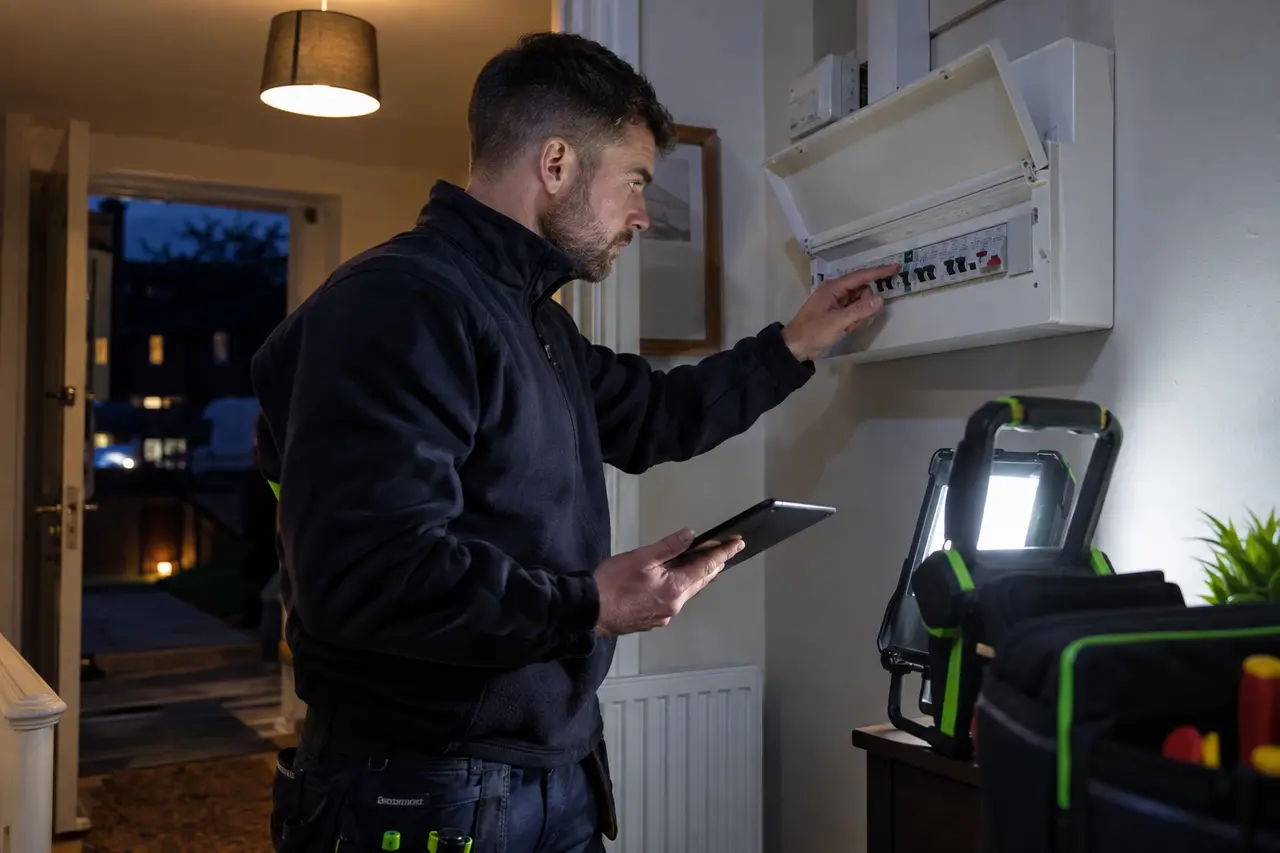 Scope checked before work begins
Book urgent electrical help in Nottingham
Contact Electrician24 about an electrical fault that needs an urgent assessment at a Nottingham property. Explain what has happened, whether the problem is continuing and where people can wait safely. The immediate objective is to establish the right response to the incident. An appointment to investigate a failed circuit is different from an emergency services response to a fire, and neither should be confused with a network operator restoring an area power cut.
Use the call button for an urgent enquiry. A written message can help describe the incident, but sending a WhatsApp message does not confirm that somebody has read it, accepted the job or started travelling. Ask for an explicit appointment response. If attendance cannot be confirmed, make another suitable arrangement instead of assuming that the existence of this page means help is on its way.
The service covers enquiries about the property's electrical installation: damaged accessories, unexplained loss of power, repeated protective-device operation and situations where an affected part may need to remain disconnected. Give the actual address and the best contact number for somebody at the premises. A relative arranging assistance from elsewhere should distinguish what they have personally seen from information passed on by the occupier.
For fire, smoke or an immediate threat to life, leave the danger area and call 999. Do not delay that call to request a quotation. For a power cut or a dangerous electricity-network problem, 105 connects callers to the relevant network operator. The operator's emergency contact information explains that route. Electrician24 does not operate the public electricity network and cannot promise restoration of a network supply.
Describe the incident without investigating it yourself
Say what changed first
The most useful opening description is a short sequence: what was operating, what changed and what remains affected. For example, mention that the downstairs sockets stopped working while the upstairs lights stayed on, or that a noise was noticed near an accessory before a circuit went off. These are observations that help scope the visit; they are not instructions to reproduce the event or decide which component has failed.
Tell the booking contact whether the condition is present now. A smell that was noticed yesterday, an accessory that is visibly damaged and equipment that is actively smoking require different discussions. Do not touch an item to find out how hot it is. If the source cannot be identified from a safe position, describe the room and circumstances rather than moving furniture, opening covers or following a smell into an unsafe space.
Separate symptoms from assumptions
Expressions such as “the fuse has gone” or “the socket needs replacing” can conceal an uncertain diagnosis. It is fine to use everyday language, but explain what you actually observed alongside it. A photograph of the outside of a closed board may help identify labels if it can be taken safely. Nobody needs to expose live equipment to supply a clearer picture for a booking enquiry.
If several people have been involved, identify any actions already taken and by whom. An attending electrician needs to know that another contractor has disconnected something, that the network operator has attended or that a resident has attempted to reset a protective device. Do not repeat an earlier action merely to check whether it still produces the same symptom. Preserve the history as information for the assessment.
Choose the right urgent electrical service
A circuit or accessory may need to remain out of use
The electrical emergency make-safe service is relevant when the first requirement is to deal with an unsafe condition rather than immediately reinstate every function. Describe which part of the premises depends on the affected equipment. A safe outcome can include a circuit remaining unavailable with a clear explanation of the restriction and the next work needed.
This distinction matters when the customer is asking for electricity to be restored at any cost. A socket used by an essential appliance may still need to stay out of service if the assessment identifies a problem. Discuss the practical consequences of that decision with the attending electrician, but do not ask for a protective device to be bypassed or for a suspect circuit to be energised just for convenience.
Some or all of the property has lost power
Use power loss diagnostics for an enquiry about an installation fault after describing any known wider outage. Tell the contact whether the loss affects the whole address, a floor, a room or selected equipment. In a divided building, specify the flat or unit and whether the communal parts are also affected. An address alone may not identify the relevant electrical supply.
Do not interpret neighbours having power as proof that the public supply to your particular property is sound. Equally, an area outage does not establish that every internal circuit is free from faults. The relevant parties need to establish their respective boundaries. If you already have a network incident reference, keep it available so that the electrical appointment can be discussed in the context of that information.
There is damage or unusual activity at a socket
A sparking socket callout focuses the enquiry on an accessory and its associated circuit. Report the location, the connected appliance and any visible discolouration without touching or dismantling the item. Avoid using that point while arranging professional advice. A decorative replacement faceplate is not a diagnosis and should not be bought on the assumption that the visible part is the entire problem.
An electrical burning smell investigation starts with a different uncertainty: the source may not be visible. Explain whether the smell appeared when equipment was operating and whether there were other observations, such as flickering or a noise. Active smoke or fire belongs with the emergency services. A commercial callout should never be treated as an alternative to that response.
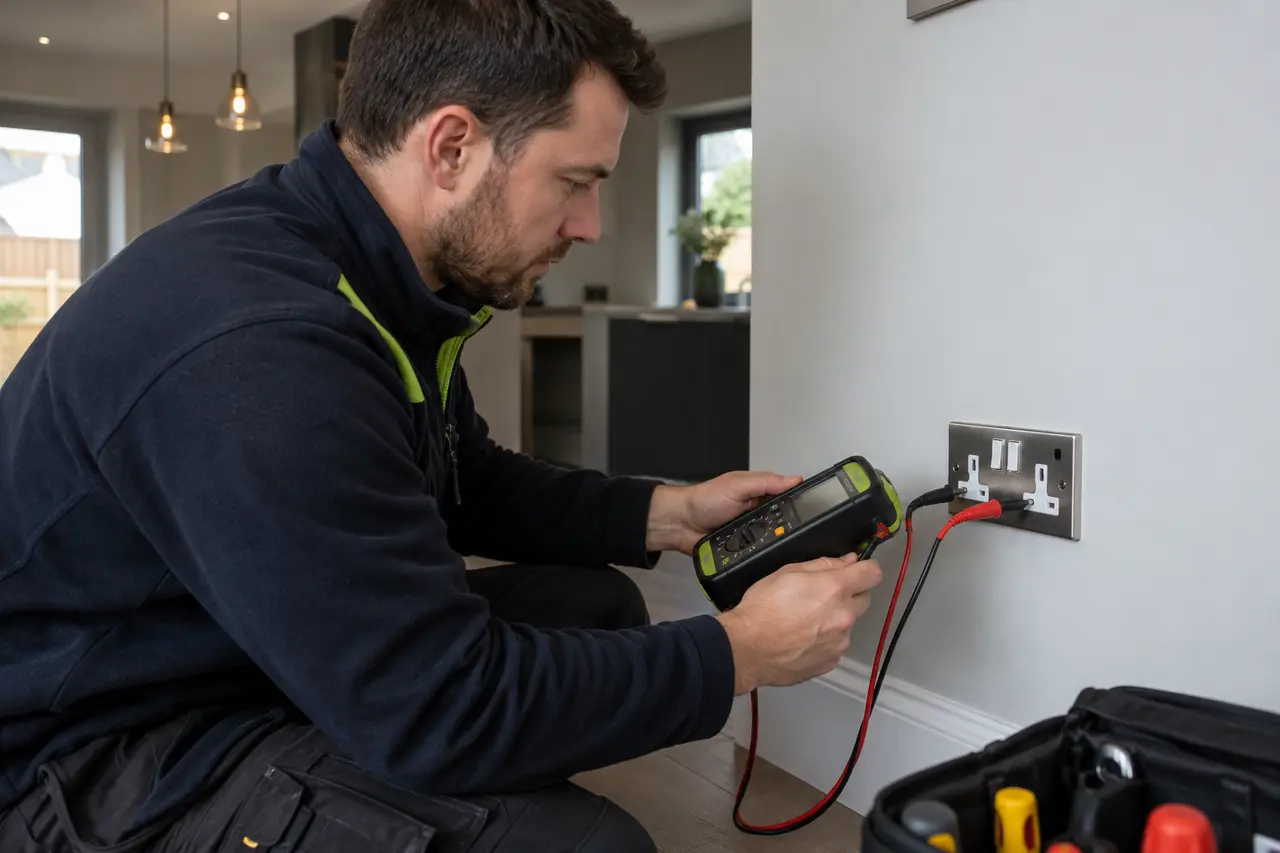
Confirm attendance before planning around a visit
An enquiry should end with a clear understanding of whether an appointment has actually been offered. Ask who is attending, what time window has been agreed and which telephone number will be used if access arrangements change. A general statement that the business covers Nottingham is not an arrival estimate for a specific incident. The condition of the installation and the availability of a suitable electrician both matter.
Where the work is outside ordinary arrangements, establish that explicitly before agreeing. Do not infer overnight cover, immediate dispatch or a fixed journey time from the business name. Tell the booking contact if the premises will become inaccessible after a certain time, if a building manager holds the keys or if the occupier cannot receive telephone calls. These practical constraints can determine whether a proposed attendance is workable.
Electrician24 lists a West Bridgford contact base and takes enquiries across Nottingham and surrounding areas. Use the service area directory to locate the relevant place, then confirm the precise postcode for the visit. Location pages describe enquiry routes; they do not establish a separate office or an electrician waiting in every listed neighbourhood. The booking conversation must resolve actual availability at your address.
Agree the first attendance scope and charge
Establish what the initial allowance buys
Ask whether the proposed charge covers attendance, an initial period of investigation, a defined make-safe action or a combination of those items. These are different commitments. A fee described only as a callout charge does not tell you how much testing or repair work is included. Confirm the arrangement in a form you can retain, particularly when the person paying will not be present at the property.
The initial scope should identify what happens when that allowance is reached. You may want the electrician to contact a named person before continuing, or to stop after an agreed assessment and explain the options. Set that instruction at the outset. A financial limit does not require the electrician to leave an installation energised if doing so would create danger; discuss the consequences of stopping work as part of the agreement.
Keep repair authority separate from the first call
Finding a damaged connection, identifying a failed component and replacing a length of concealed cable are not interchangeable jobs. The electrician may be able to propose a limited repair or may need access that was not foreseeable over the phone. Ask for the reason, the proposed work and the additional cost basis before giving approval. Urgency does not remove the need to understand what is being authorised.
Use pricing and written estimates when you need to compare an immediate attendance with a later repair proposal. Record whether materials, further visits and any applicable tax are included. If an insurer, landlord or managing agent may contribute, obtain that party's instructions directly. Electrician24 cannot establish insurance coverage simply by describing a fault as an emergency, and the payer should not assume reimbursement without confirmation.
Arrange access for the installation being assessed
A house with one readily accessible board
Identify where the board is located and whether the approach is currently usable. Keep other people away from the incident area, but do not move damaged equipment or enter a hazardous space to improve access. If the board is in a cupboard used for storage, describe that fact during the enquiry. Access preparation should never involve removing electrical covers or disturbing wiring before the electrician arrives.
The affected circuit may extend beyond the room where the symptom appeared. Tell the electrician about locked rooms, a loft used for storage, an attached outbuilding or a section of the property occupied separately. This information allows the investigation boundary to be discussed. Do not promise access on behalf of another occupier unless they have actually agreed to it, especially in a shared or subdivided building.
Flats, communal entrances and managed buildings
A flat's private installation can sit alongside equipment controlled by a freeholder or managing agent. Provide the flat number, the entrance instructions and the contact for shared electrical cupboards. If common-area lighting, a door-entry system or several units are affected, say so at the beginning. An electrician attending one resident cannot automatically authorise work on every part of the building.
For a managed property, distinguish permission to enter from permission to undertake repairs. The resident may have a key but no authority to approve work on communal equipment; the agent may authorise work but be unable to supply access after office hours. Resolve both questions if possible before confirming an appointment. A failed access arrangement can delay an assessment even when somebody is available to attend.
Urgent faults in rented homes and shared accommodation
A tenant reporting a problem should tell the landlord or managing agent through their established repair contact while taking any necessary emergency action. If the tenant contacts Electrician24 directly, identify who is expected to approve and pay for the electrical visit. The person arranging access and the person instructing the work can be different, but that difference must be clear before commercial terms are accepted.
For landlords, send the actual fault description rather than forwarding only “tenant has no electric”. Include the tenant's contact arrangements, any known restrictions on entry and the available inspection or repair record. If the report relates to an earlier repair, provide its date and the relevant circuit or accessory. That context is more useful than a general assertion that the installation was previously checked.
In shared accommodation, losing a circuit can affect people who are not part of the original call. Identify the responsible contact for informing occupiers and explain any known dependence on alarms, heating controls or access systems. Do not assume that every socket serving an individual room is confined to that room's circuit. The attending electrician must establish the installation arrangement rather than rely on bedroom numbering.
Follow-on remedial coordination belongs with the landlord and HMO electrical service. An urgent visit may address a particular defect without resolving every observation in an existing report. Keep those two scopes distinct. The landlord needs a record of what the emergency attendance actually achieved and a separate understanding of any other work still requiring attention.
Protect business operations without demanding unsafe restoration
Identify what the affected circuit supports
For a shop, office or other workplace, name the equipment that cannot operate and any systems affected by an interruption. A failed socket serving one printer is a different booking problem from an outage affecting refrigeration, access control or an entire distribution area. Give the site contact enough context to understand the consequences without asking them to diagnose a complex installation from an equipment list.
Identify the person who can approve a shutdown and communicate it to staff. Testing or repair may interrupt equipment beyond the point that visibly failed. Let the electrician know if a process needs an orderly stop or if another specialist must be present to restart it. Do not describe a visit as uninterrupted working unless that method has been assessed and specifically agreed by those responsible for the installation.
Separate electrical attendance from business continuity decisions
The electrical assessment addresses the installation and the agreed task. Decisions about reopening premises, safeguarding stock, relocating staff or continuing a regulated activity belong with the business's responsible people and relevant advisers. An electrician should not be treated as having approved every operational consequence merely because one circuit has been repaired. Ask for a precise description of the electrical outcome.
Use commercial electrical services for work that needs a planned shutdown or broader distribution assessment after the incident. Keep the emergency job reference and describe any restrictions left in place. This helps the next appointment start from the actual condition at handover rather than from an assumption that the entire site returned to its previous operating state.
Situations that change the make-safe and repair sequence
Water has reached electrical equipment
Report a leak or water ingress before discussing restoration. Describe its location from a safe position and whether a plumber, roofer or building manager is already involved. Do not touch wet electrical equipment or attempt a demonstration for a video. The water source and the affected electrical installation may require different contractors, and stopping the leak does not by itself establish that the electrical equipment can be reused.
The electrical visit should clarify the assessed area, any parts left unavailable and what must happen before restoration can be considered. Damage hidden inside equipment cannot be ruled out from the appearance of the outside. Ask who will arrange the next assessment and whether access depends on building work. A follow-up appointment needs a defined purpose, not just a request to switch the power back on.
Building work preceded the fault
If drilling, fixing, flooring work or a kitchen alteration happened shortly before the fault, provide that sequence and the location of the activity. Do not remove new fixings or open finishes to prove a suspected cable route. The electrician can decide what inspection and access are appropriate. Tell the other contractor that an electrical problem has been reported so that further work does not disturb the area before it is assessed.
Where opening a wall, floor or ceiling is proposed, distinguish the electrical investigation from making good the building fabric. An urgent quotation may not include plastering, decorative finishes or specialist access. Agree who will undertake those tasks and who must approve the proposed opening. Being clear about that boundary reduces the risk of an essential repair ending with an unexpected dispute about the surrounding property.
There is more than one source of electrical energy
Mention solar panels, battery storage, a generator, an uninterruptible power supply or other equipment that may be connected to the installation. Do not assume that an ordinary-looking board represents every possible source. This is information for the electrician's assessment, not an invitation for an occupier to identify isolation points. Supply existing equipment documentation if it is available without approaching damaged components.
A specialist system may need its installer or service provider involved. Tell the booking contact whether you have an existing support agreement and whether an error message has appeared. Keep the precise message rather than paraphrasing it as a general power failure. Confirm which contractor is taking responsibility for each part of the job before arranging overlapping visits that might depend on incompatible access or shutdown arrangements.
Understand the possible outcomes before the electrician leaves
A defined repair is completed
If a repair is completed, ask which fault was identified, what was changed and what checks relate to that work. Keep the job description specific enough to recognise the repaired point or circuit later. “Electrics fixed” is a weak record when there are multiple boards or several previous issues. The documentation should reflect the actual work, and any certificate required for that work should be discussed with the electrician.
Demonstrating that an appliance operates again is useful for the customer, but it is not a substitute for the electrician's necessary verification of the repair. Equally, a repair to one part does not establish the condition of every concealed cable in the building. Ask whether the visit identified concerns outside the agreed task and how those concerns should be taken forward without confusing them with completed work.
The fault is contained but restoration remains outstanding
Where the affected part stays disconnected, establish exactly what must not be used and who has been told. A restriction should be understandable to someone who did not witness the visit. Ask for a clear next step: a further investigation, a particular repair proposal, another contractor's attendance or access that could not be obtained. Avoid treating a provisional arrangement as permanent merely because daily life becomes manageable around it.
Tell the electrician about foreseeable changes before the follow-up visit, such as a new occupier arriving, a business reopening or builders returning. Those changes may affect how restrictions are communicated. Keep the handover record with the person responsible for the premises. If the incident affects people who were absent, arrange for them to receive the relevant instructions rather than relying on an informal message passed between residents.
The original symptom cannot be reproduced
An intermittent fault may not present during the appointment. Ask what was assessed and what remains uncertain. Absence of the symptom at that moment is not a diagnosis of every possible cause. Keep a factual record of later events from a safe position, and do not deliberately create the conditions again. A planned fault-finding appointment may be appropriate when the immediate situation has been addressed but the cause needs more time to establish.
Keep an unattended property secure after the incident
Tell the electrician before everybody leaves
A property can be electrically safer after a circuit is disconnected yet become difficult to secure if a powered shutter, entry system or gate no longer operates. Identify those dependencies before the visit concludes. The electrician needs to know whether the person providing access will leave immediately and whether another occupier is expected later. Decisions about security should be made alongside the electrical handover, without asking for defective equipment to be restored simply to lock the premises.
Keep a separate contact for any specialist access or alarm system where one exists. That contractor may need to explain an authorised alternative operating arrangement. Do not force equipment or improvise connections to overcome a loss of power. If a building manager controls the entrance, involve them in the departure arrangements. An emergency electrician attending a circuit fault should not be assumed to hold the information or authority needed to reconfigure every security product at the address.
For an empty rental property, agree who checks that the premises are secured and who receives the restriction record. A letting agent holding a key may visit after the electrician has gone; they need to know which equipment must remain out of use. Remove ambiguity from the handover by naming the recipient and arranging how the message reaches them. A note visible only to the person originally present may be inadequate when responsibility changes between visits.
Preserve the incident history for the next responsible person
When the owner is away, ask the person at the property to retain the time of the incident, the appointment details and the electrician's description of the outcome. Keep these with the relevant job documents. Record observations about affected equipment without inventing an estimate of damage or attributing blame. A landlord, insurer or later repair contractor may need accurate facts, but those parties can decide what further evidence or assessment they require.
Do not discard damaged components specifically needed for another party's assessment without first clarifying the arrangement with the electrician and that party. There may also be a safety reason for removal or controlled disposal. The practical question is who retains what information and whether photographs taken during professional work can form part of the record. Nobody should store an unsafe item in an accessible position merely because a claim or disagreement might arise later.
If a cleaner, builder or property viewer is due to enter before the follow-up repair, tell the person organising that visit about the electrical restrictions. They should not discover the issue by trying an unavailable accessory. The restriction concerns use of the installation, not only the identity of the person who originally booked. Communicating it to the next occupier is particularly important where a key safe or agent-managed access means nobody provides an in-person handover.
A useful urgent-enquiry message
Provide the postcode, property or unit number, your callback number and a description of the incident in ordinary language. Add whether anybody is at the premises, whether an active danger has already been reported and whether the network operator or another contractor has attended. State which facts you know directly. The purpose is to establish a workable response, not to supply a remote electrical test result.
For a landlord or facilities enquiry, include the authorising contact and any initial spending instruction. For a property where access is controlled, identify the keyholder and entry arrangements. Avoid sending alarm codes, access credentials or unrelated personal documents in an initial public message. Those details can be handled through an appropriate arrangement once the identity and attendance of the contractor have been confirmed.
Ask for the proposed attendance window, the initial charge basis and the point at which further approval will be sought. If an offered arrangement does not meet the urgency or access constraints, say so immediately. A useful booking is an agreed plan between the people responsible, not simply a sent message. The booking page provides the general contact route for work that can be arranged after the urgent issue is contained.
Frequently asked questions about urgent attendance
Is calling Electrician24 the right response to smoke from electrical equipment?
Smoke, fire or immediate danger to life requires the emergency services, not a commercial booking conversation. Leave the dangerous area and call 999. Once the emergency response permits access, an electrical assessment may be needed to establish the condition of the installation and the work required before affected equipment can be returned to use. Do not take close-up pictures, collect possessions from the incident area or wait for a quote while an active emergency continues.
Can an appointment restore electricity during a neighbourhood power cut?
An electrician working on your installation cannot restore the public network. Report the outage through 105 and keep any incident reference or restoration information the network operator supplies. An internal fault may still need attention if there are separate symptoms at the property. Explain the known network situation when enquiring so that the purpose of any electrical visit is clear rather than assuming that a private callout will shorten the external outage.
Does a repeated trip mean the protective device itself needs replacing?
Not necessarily. Report which device appears to operate, if its label is visible safely, and what was happening at the time. The installation and connected equipment need appropriate assessment before a replacement is specified. Repeatedly operating the device or asking for a higher-rated replacement is not a diagnosis. A booking should allow the electrician to establish the cause, not commit them to a customer-selected component before the fault has been investigated.
Should I send a video of the sparking to demonstrate the problem?
Do not reproduce sparking or remain near damaged equipment to obtain evidence. A description of what was already observed is sufficient for the initial enquiry. Existing footage can be useful if it was obtained safely, but no video can establish every condition inside an accessory or its circuit. Tell the contact where the incident occurred and whether the affected equipment is still being used. Immediate safety takes priority over providing a visually persuasive booking message.
Can the urgent visit be limited to making the installation safe?
Yes, the proposed first scope can focus on assessment and a make-safe outcome where appropriate. Confirm what that means for the particular incident and what information will be provided afterwards. Some equipment may remain unavailable, and a separate appointment may be needed for diagnosis or repair. Agree how further work will be authorised rather than assuming that a limited instruction guarantees either complete restoration or a particular action before the installation has been examined.
What should an off-site landlord arrange before an emergency appointment?
Provide an occupier or keyholder contact, the correct property identifier and a person authorised to approve expenditure. Explain any initial limit and how additional findings should be reported. If relevant documents exist, send the parts identifying the circuit or previous fault. The landlord should also arrange communication with affected residents. An electrician being able to enter the property does not automatically mean that the resident can approve all remedial work on the owner's behalf.
Will a callout include a full EICR for the property?
Do not assume that it will. An urgent fault assessment and an inspection of the wider fixed installation serve different purposes and need different scopes. If you require a condition report as well, discuss that separately through electrical testing and EICRs. The urgent job record should describe the issue attended and the work undertaken, without presenting a targeted intervention as evidence that every circuit and accessible part has received a complete periodic inspection.
What if the board is inside a locked communal cupboard?
Tell the booking contact before accepting an attendance slot. Identify the managing agent, caretaker or other person able to release access and establish when they can do so. Do not break into a cupboard or interfere with equipment controlled by someone else. The electrician needs to understand both the physical access restriction and who has authority over the installation. A visit to an individual flat may otherwise reach a limit that cannot be resolved by the resident alone.
Can I leave the property and ask the electrician to collect a key?
Discuss that arrangement explicitly, including who hands over the key and who can approve decisions during the visit. The electrician may need information from the person who witnessed the incident or access to several rooms. An unattended property also needs a clear plan for securing it afterwards and communicating any restrictions. Do not assume a key collection service is included in an urgent booking or leave keys in an exposed location without an agreed arrangement.
Is a hot socket always a small repair?
The visible accessory does not establish the extent of the problem. The electrician may need to assess its connections, associated wiring and the equipment being supplied before proposing a repair. Describe heat or damage already noticed without touching the socket to check it again. The initial charge and repair authority should allow for findings that differ from the customer's first impression, while still requiring an explanation before additional work beyond the agreed scope is undertaken.
Can a business stay open while the electrical fault is investigated?
That depends on the incident, the installation and the business's own responsibilities. Identify the equipment and areas that could be affected by isolation, and nominate somebody authorised to coordinate the shutdown. The electrician must determine an appropriate working arrangement; the operator remains responsible for decisions about trading and occupancy. Do not promise staff or customers uninterrupted operation before the electrical work and any related operational restrictions have been assessed by the relevant people.
What changes if a leak caused the electrical problem?
Explain the water source, affected area and any contractor already addressing the leak. The electrical assessment and the building repair may need coordination, and equipment may remain unavailable until its condition can be established. A dry surface or a stopped leak is not evidence that every affected electrical component is serviceable. Ask what must happen before reconnection can be considered and who is responsible for arranging that next stage, particularly when several parties are instructing different contractors.
Are replacement parts guaranteed to be available during the first visit?
No particular part should be assumed available until the equipment and required repair have been identified. Some installations contain components that require a specific compatible replacement or a wider alteration. Ask how sourcing, a further visit and any interim restriction would be handled. Buying a part in advance can create another problem if it is unsuitable. A clear diagnosis and repair specification are more useful than a general promise that every emergency can be completed immediately.
Should I contact an appliance engineer or an electrician?
Describe both the appliance symptom and what happened to the fixed installation. A fault associated with one item can require a different contractor from a damaged socket or circuit. The initial conversation should clarify the proposed scope without guaranteeing a remote diagnosis. Keep model and warranty information if an appliance is involved, and do not dismantle it. Where responsibility remains uncertain, ask which checks the electrical visit will cover and what outcome would require referral to an appliance specialist.
Can I approve repairs by telephone while someone else provides access?
That can be arranged if the booking contact accepts the instruction and can reach you when a decision is required. Supply the correct callback number and explain any limits in advance. The person at the property needs to know who is authorising the work. If you become unavailable, the visit may reach an agreed stopping point or leave affected equipment disconnected. A remote approval arrangement works best when the scope, cost communication and handover recipient are all identified beforehand.
What should I retain after an urgent electrical repair?
Keep the invoice or job record, the description of the defect, the work completed and any relevant certification supplied for that work. Also retain instructions about equipment left unavailable and the proposed follow-up. Link these records to the actual address, board or circuit where possible. They can help a future contractor distinguish a repaired issue from a new symptom. A vague payment receipt is less useful than a document explaining the limits and outcome of the attendance.
What if the fault returns after the electrician has left?
Describe the new event, refer to the previous job and say whether the symptom matches what was originally reported. Do not assume either that the completed repair has failed or that the new issue is unrelated. The contractor needs the circumstances to decide the appropriate response and explain any applicable workmanship or callout terms. If the recurrence involves an immediate danger, follow the emergency route first rather than waiting for an administrative discussion about the earlier invoice.
Can an urgent callout include replacing the whole consumer unit?
That should not be assumed from the initial enquiry. A consumer-unit replacement needs its own assessment, equipment selection, isolation arrangements, testing and documentation. An emergency assessment may identify reasons to consider it, but a board replacement is not a universal remedy for every fault. If that option is proposed, ask how it relates to the findings and which existing circuit defects would remain to be addressed. The consumer-unit service explains the separate project scope.
Can I request the cheapest action that gets the power back on?
You can explain your budget and ask for the options, but restoration must depend on the electrician's assessment of the installation. A lower initial cost may involve leaving a defective part disconnected and planning later work. It cannot require bypassing protection or concealing an unresolved problem. Ask which actions are necessary now, which are optional improvements and which would be separate repairs. That distinction supports an informed decision without treating a functioning appliance as the only measure of an acceptable outcome.
How do I know that my urgent enquiry has become a confirmed booking?
Look for an explicit acceptance stating the attendance arrangement, the property, the initial scope and the charge basis. If these points are missing, ask for clarification through the contact you are using. An automated message, a delivered WhatsApp indicator or the completion of a website form is not equivalent to a confirmed appointment. Keep the agreed callback route available and tell the booking contact if the situation or access changes before the proposed visit.
Choose the specialist service
Emergency Electrician
Urgent electrical assessment and sensible make-safe decisions for homes, landlords and local businesses.
Open service Emergency electrical helpElectrical Emergency Make-Safe
Initial isolation and make-safe work where an accessible electrical fault presents an immediate concern.
Open service Emergency electrical helpPower Loss Diagnostics
Checks for partial or complete loss of power after supply issues and obvious external causes have been ruled out.
Open service Emergency electrical helpSparking Socket Callout
Assessment of sparking, heat damage or unusual noises at sockets and connected accessories.
Open service Emergency electrical helpBurning Smell Investigation
Prompt investigation of unexplained electrical burning smells, hot accessories and signs of damaged connections.
Open serviceDescribe the urgent fault
An existing fault report can help if it is already available. Do not delay seeking urgent help to look for paperwork.
For fire, smoke or immediate danger to life, move to safety and call emergency services. This message does not book an emergency attendance.
Emergency electrical help: choose your location
These groups organise enquiries. Confirm the property postcode and appointment availability before booking.
West Bridgford and south Nottingham
Inner and north Nottingham
East Nottingham and the Trent villages
West Nottingham and the Erewash area
North-west Nottingham
Rushcliffe and the Vale
Derby and the Derwent area
Mansfield and north Nottinghamshire
Newark area
Loughborough and north Leicestershire
Need to discuss emergency electrician?
Send the postcode, the affected circuit or appliance and what changed before the problem started.