
Electrical Fault Finding in Nottingham: Scope, Safety, Testing and Records
Structured testing to narrow down circuit faults before parts or wiring are replaced.
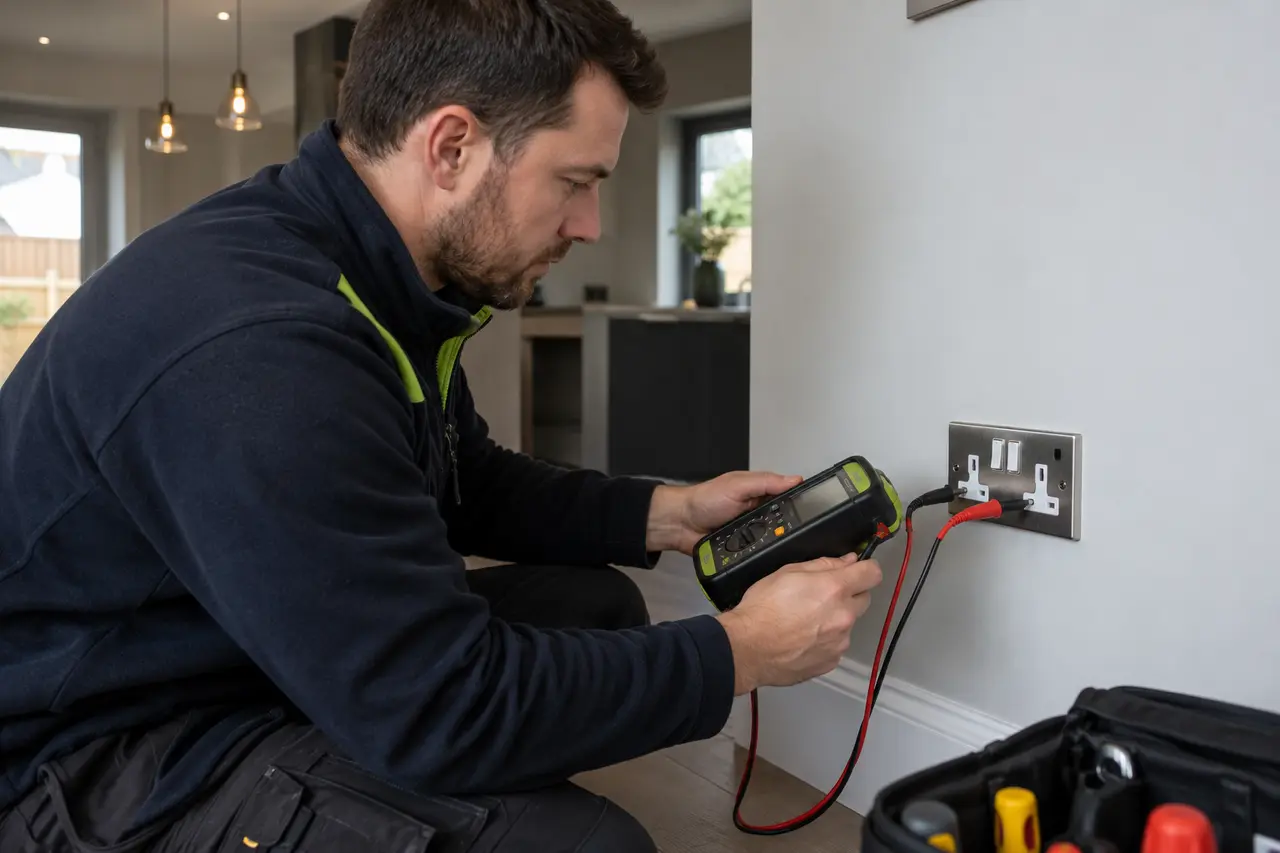 Scope checked before work begins
When is electrical fault finding relevant?
Structured testing to narrow down circuit faults before parts or wiring are replaced. An electrician still needs to check the actual installation and test evidence before confirming the repair or installation route.
Do not remove covers or touch exposed electrical parts. If there is smoke, fire or an immediate danger to life, move away and contact the appropriate emergency service.
Electrical fault finding
An intermittent fault may disappear before the visit. A written sequence of symptoms, affected circuits and recent changes helps the investigation. Agree diagnostic scope first and review the test findings before authorising replacements.
Before arranging this work
Does the fault coincide with an appliance, weather condition or time of day?
How this work fits the wider installation
A socket that stops working can reflect a failed accessory, a damaged connection or a fault elsewhere on its circuit. Recording when a problem occurs helps separate an installation fault from an appliance problem. Testing should narrow the cause before a replacement is proposed.
- Identify the circuit or accessory and whether the fault is intermittent.
- Explain recent drilling, leaks, alterations or new appliances.
- Ask for the finding, proposed repair and any unresolved limitations.
Agree the boundaries
An initial diagnostic allowance is not a fixed price for every possible repair. Concealed wiring and intermittent faults can need further investigation.
Prepare for the first conversation
Keep a note of the time, affected rooms and equipment in use when the fault appears.
How appointments and work are agreedElectrical fault finding: questions before booking
Should I buy a replacement socket before booking?
Wait for the diagnosis. The visible socket may not be the cause, and the correct accessory depends on the circuit, back box and intended use.
What should I send before booking?
Keep a note of the time, affected rooms and equipment in use when the fault appears.
What needs to be agreed in the estimate?
An initial diagnostic allowance is not a fixed price for every possible repair. Concealed wiring and intermittent faults can need further investigation.
Find electrical fault finding near you
Electrical Fault Finding: detailed electrical service scope, booking and handover
This service content explains what customers can request, which property details are needed, how scope and testing are agreed, and which records and handover information should follow the work.
Electrical Fault Finding in Nottingham should be discussed from the actual property and installation: identify immediate danger, describe the affected circuit or intended outcome, explain access and occupancy, provide existing reports and agree the scope, testing and documentation before work proceeds. This electrical service page helps an occupier, landlord or business prepare that information while keeping diagnosis, safe isolation, compliance and certification decisions with the competent person responsible for the real installation.
Explore this page
What electrical Fault Finding means in practice before work begins
The safest approach is to keep uncertainty visible until a competent person can assess the installation. In this electrical service page, electrical Fault Finding in Nottingham is treated as fault finding and urgent electrical assessment. Useful observations include what changed before the fault, which rooms or circuits are affected, whether a protective device has operated, visible damage, heat, smell, sound and whether water or fire is involved. Begin with the outcome and the evidence available, not with an assumed repair or certificate. The same symptom can have different causes, and the same installation request can require different design, access, testing and notification decisions.
The area can contain terraces, flats, converted buildings, managed blocks, limited parking and installations altered at different times, but the actual property, occupancy, supply and installation must be described instead of inferred from the location name. The enquiry should distinguish observations made safely by the customer from conclusions that require inspection, measurement and testing. Using the same facts through the appointment makes changes easier to authorise and document.
Practical steps for electrical fault finding in Nottingham
Applied to electrical Fault Finding in Nottingham, the task is to turn the available evidence into one current instruction. Describe the property, affected equipment, what changed and what you need the installation to do after the work. The appropriate method is a controlled assessment that establishes immediate safety before diagnosis and any repair proposal. For this appointment, access, occupancy, communal areas and the position of meters and distribution equipment should be described before the visit. State what is known, identify what has not been safely checked, name the person able to authorise a change and confirm who needs the final certificate, report or commissioning information.
The occupier, person approving the work and recipient of the final records may be different people, so their roles should be named. It preserves the boundary between customer information and decisions for which the competent person is responsible.
Limits, records and the next decision
The limitation is as important as the action on this electrical service page. A website cannot remotely establish safety, compliance, fault cause, circuit capacity or the exact work required. For fault finding and urgent electrical assessment, avoid repeatedly resetting a protective device, touching damaged parts, removing covers, energising a wet installation or treating a temporary return of power as proof that the fault is resolved. General online information cannot diagnose concealed wiring, authorise live work, confirm circuit capacity, certify compliance or guarantee the result of inspection and testing.
Keep the decision tied to the real installation in Nottingham, competent assessment, the agreed scope and the correct records. The enquiry should distinguish observations made safely by the customer from conclusions that require inspection, measurement and testing. This is more useful than trying to diagnose hidden wiring or choose a compliance route from a photograph.
Recognise when to stop and make the area safe before work begins
This issue deserves attention because a small missing detail can change access, isolation, testing, materials or documentation. In this electrical service page, electrical Fault Finding in Nottingham is treated as fault finding and urgent electrical assessment. Useful observations include what changed before the fault, which rooms or circuits are affected, whether a protective device has operated, visible damage, heat, smell, sound and whether water or fire is involved. Smoke, fire, exposed conductors, severe heat, water near electrical equipment and signs of arcing require immediate caution.
Buzzing, crackling, scorch marks, repeated protective-device operation and a burning smell may indicate conditions that should not be investigated by an untrained occupant. The area can contain terraces, flats, converted buildings, managed blocks, limited parking and installations altered at different times, but the actual property, occupancy, supply and installation must be described instead of inferred from the location name. Existing reports and circuit information are useful evidence, but they must be checked against the installation that is actually present. It preserves the boundary between customer information and decisions for which the competent person is responsible.
Practical steps for electrical fault finding in Nottingham
Applied to electrical Fault Finding in Nottingham, the task is to turn the available evidence into one current instruction. Move people away, avoid touching damaged equipment and contact the appropriate emergency service where there is fire or immediate danger to life. The appropriate method is a controlled assessment that establishes immediate safety before diagnosis and any repair proposal. For this appointment, access, occupancy, communal areas and the position of meters and distribution equipment should be described before the visit. State what is known, identify what has not been safely checked, name the person able to authorise a change and confirm who needs the final certificate, report or commissioning information.
Critical equipment, vulnerable occupants and business operations should be identified before any shutdown window is treated as acceptable. It preserves the boundary between customer information and decisions for which the competent person is responsible.
Limits, records and the next decision
The limitation is as important as the action on this electrical service page. Do not remove covers, reach into equipment, use water on electrical fire or re-energise a circuit simply to see whether the problem returns. For fault finding and urgent electrical assessment, avoid repeatedly resetting a protective device, touching damaged parts, removing covers, energising a wet installation or treating a temporary return of power as proof that the fault is resolved. General online information cannot diagnose concealed wiring, authorise live work, confirm circuit capacity, certify compliance or guarantee the result of inspection and testing.
Keep the decision tied to the real installation in Nottingham, competent assessment, the agreed scope and the correct records. A domestic home, managed block and workplace can share a postcode area while requiring very different access, isolation and documentation plans. It also provides a clear basis for comparing the planned work with what is found at the property.
Record symptoms without diagnosing the fault: the practical decision
The practical value of this service information is that it gives the electrician usable context before any work is assumed. In this electrical service page, electrical Fault Finding in Nottingham is treated as fault finding and urgent electrical assessment. Useful observations include what changed before the fault, which rooms or circuits are affected, whether a protective device has operated, visible damage, heat, smell, sound and whether water or fire is involved. A clear timeline helps a competent person decide what to inspect first. Note which lights, sockets, appliances or rooms are affected, what was switched on, any smell or sound, weather conditions and which breaker, RCD or RCBO operated.
The area can contain terraces, flats, converted buildings, managed blocks, limited parking and installations altered at different times, but the actual property, occupancy, supply and installation must be described instead of inferred from the location name. The enquiry should distinguish observations made safely by the customer from conclusions that require inspection, measurement and testing. It preserves the boundary between customer information and decisions for which the competent person is responsible.
Practical steps for electrical fault finding in Nottingham
Applied to electrical Fault Finding in Nottingham, the task is to turn the available evidence into one current instruction. Use ordinary words, provide safe photographs of labels or visible damage and say what has already been tried. The appropriate method is a controlled assessment that establishes immediate safety before diagnosis and any repair proposal. For this appointment, access, occupancy, communal areas and the position of meters and distribution equipment should be described before the visit. State what is known, identify what has not been safely checked, name the person able to authorise a change and confirm who needs the final certificate, report or commissioning information.
A domestic home, managed block and workplace can share a postcode area while requiring very different access, isolation and documentation plans. Using the same facts through the appointment makes changes easier to authorise and document.
Limits, records and the next decision
The limitation is as important as the action on this electrical service page. Do not represent a guessed cause as fact or continue repeated resets that may conceal an intermittent or dangerous fault. For fault finding and urgent electrical assessment, avoid repeatedly resetting a protective device, touching damaged parts, removing covers, energising a wet installation or treating a temporary return of power as proof that the fault is resolved. General online information cannot diagnose concealed wiring, authorise live work, confirm circuit capacity, certify compliance or guarantee the result of inspection and testing.
Keep the decision tied to the real installation in Nottingham, competent assessment, the agreed scope and the correct records. The enquiry should distinguish observations made safely by the customer from conclusions that require inspection, measurement and testing. It preserves the boundary between customer information and decisions for which the competent person is responsible.
Describe the property and installation in Nottingham without unsafe assumptions
For an occupier, landlord, agent or site manager, this is where a broad request becomes a clear property brief. In this electrical service page, electrical Fault Finding in Nottingham is treated as fault finding and urgent electrical assessment. Useful observations include what changed before the fault, which rooms or circuits are affected, whether a protective device has operated, visible damage, heat, smell, sound and whether water or fire is involved. Property type, age, occupancy and use influence access, circuit arrangements and the consequences of isolation.
A flat with communal supplies, an HMO, an older house, a new-build, a shop and a workshop can each require different contacts and records. The area can contain terraces, flats, converted buildings, managed blocks, limited parking and installations altered at different times, but the actual property, occupancy, supply and installation must be described instead of inferred from the location name. The occupier, person approving the work and recipient of the final records may be different people, so their roles should be named. This is more useful than trying to diagnose hidden wiring or choose a compliance route from a photograph.
Practical steps for electrical fault finding in Nottingham
Applied to electrical Fault Finding in Nottingham, the task is to turn the available evidence into one current instruction. Give the full postcode, floor or unit, meter and consumer-unit location, parking or gate information and whether tenants or customers are present. The appropriate method is a controlled assessment that establishes immediate safety before diagnosis and any repair proposal. For this appointment, access, occupancy, communal areas and the position of meters and distribution equipment should be described before the visit. State what is known, identify what has not been safely checked, name the person able to authorise a change and confirm who needs the final certificate, report or commissioning information.
If access or testing changes the proposed scope, the finding, consequence, price effect and required record should be explained together. This is more useful than trying to diagnose hidden wiring or choose a compliance route from a photograph.
Limits, records and the next decision
The limitation is as important as the action on this electrical service page. Do not assume that nearby properties or buildings of similar age have the same wiring, protection or supply arrangement. For fault finding and urgent electrical assessment, avoid repeatedly resetting a protective device, touching damaged parts, removing covers, energising a wet installation or treating a temporary return of power as proof that the fault is resolved. General online information cannot diagnose concealed wiring, authorise live work, confirm circuit capacity, certify compliance or guarantee the result of inspection and testing.
Keep the decision tied to the real installation in Nottingham, competent assessment, the agreed scope and the correct records. The enquiry should distinguish observations made safely by the customer from conclusions that require inspection, measurement and testing. This is more useful than trying to diagnose hidden wiring or choose a compliance route from a photograph.
Identify the affected circuit or intended load: the practical decision
The safest approach is to keep uncertainty visible until a competent person can assess the installation. In this electrical service page, electrical Fault Finding in Nottingham is treated as fault finding and urgent electrical assessment. Useful observations include what changed before the fault, which rooms or circuits are affected, whether a protective device has operated, visible damage, heat, smell, sound and whether water or fire is involved. Electrical work is planned around what the circuit supplies and the conditions in which it operates. Equipment rating, diversity, cable route, protective device, earthing, bonding, voltage drop, environmental exposure and future use may all matter.
The area can contain terraces, flats, converted buildings, managed blocks, limited parking and installations altered at different times, but the actual property, occupancy, supply and installation must be described instead of inferred from the location name. Existing reports and circuit information are useful evidence, but they must be checked against the installation that is actually present. It preserves the boundary between customer information and decisions for which the competent person is responsible.
Practical steps for electrical fault finding in Nottingham
Applied to electrical Fault Finding in Nottingham, the task is to turn the available evidence into one current instruction. Provide model information for fixed equipment and explain whether the request is replacement, additional capacity, relocation or investigation. The appropriate method is a controlled assessment that establishes immediate safety before diagnosis and any repair proposal. For this appointment, access, occupancy, communal areas and the position of meters and distribution equipment should be described before the visit. State what is known, identify what has not been safely checked, name the person able to authorise a change and confirm who needs the final certificate, report or commissioning information.
The occupier, person approving the work and recipient of the final records may be different people, so their roles should be named. Using the same facts through the appointment makes changes easier to authorise and document.
Limits, records and the next decision
The limitation is as important as the action on this electrical service page. A spare way in a consumer unit or an unused socket position does not by itself prove that a new load can be connected. For fault finding and urgent electrical assessment, avoid repeatedly resetting a protective device, touching damaged parts, removing covers, energising a wet installation or treating a temporary return of power as proof that the fault is resolved. General online information cannot diagnose concealed wiring, authorise live work, confirm circuit capacity, certify compliance or guarantee the result of inspection and testing.
Keep the decision tied to the real installation in Nottingham, competent assessment, the agreed scope and the correct records. The occupier, person approving the work and recipient of the final records may be different people, so their roles should be named. It also provides a clear basis for comparing the planned work with what is found at the property.
Plan safe isolation and access before work begins
The safest approach is to keep uncertainty visible until a competent person can assess the installation. In this electrical service page, electrical Fault Finding in Nottingham is treated as fault finding and urgent electrical assessment. Useful observations include what changed before the fault, which rooms or circuits are affected, whether a protective device has operated, visible damage, heat, smell, sound and whether water or fire is involved. Work should be planned so the relevant part of the installation can be made safe and protected against unintended re-energisation.
Other occupants, business processes, alarms, refrigeration, medical equipment, servers and communal supplies can make isolation more consequential. The area can contain terraces, flats, converted buildings, managed blocks, limited parking and installations altered at different times, but the actual property, occupancy, supply and installation must be described instead of inferred from the location name. Critical equipment, vulnerable occupants and business operations should be identified before any shutdown window is treated as acceptable. It preserves the boundary between customer information and decisions for which the competent person is responsible.
Practical steps for electrical fault finding in Nottingham
Applied to electrical Fault Finding in Nottingham, the task is to turn the available evidence into one current instruction. Identify who controls the supply, what must remain operational and which shutdown windows or permissions are available. The appropriate method is a controlled assessment that establishes immediate safety before diagnosis and any repair proposal. For this appointment, access, occupancy, communal areas and the position of meters and distribution equipment should be described before the visit. State what is known, identify what has not been safely checked, name the person able to authorise a change and confirm who needs the final certificate, report or commissioning information.
If access or testing changes the proposed scope, the finding, consequence, price effect and required record should be explained together. The result is a shared understanding between the occupier, payer, electrician and person responsible for the premises.
Limits, records and the next decision
The limitation is as important as the action on this electrical service page. Occupants should not open equipment or attempt live work; the responsible person must decide the safe working method at the property. For fault finding and urgent electrical assessment, avoid repeatedly resetting a protective device, touching damaged parts, removing covers, energising a wet installation or treating a temporary return of power as proof that the fault is resolved. General online information cannot diagnose concealed wiring, authorise live work, confirm circuit capacity, certify compliance or guarantee the result of inspection and testing.
Keep the decision tied to the real installation in Nottingham, competent assessment, the agreed scope and the correct records. Existing reports and circuit information are useful evidence, but they must be checked against the installation that is actually present. It preserves the boundary between customer information and decisions for which the competent person is responsible.
Separate inspection, diagnosis and repair before work begins
This issue deserves attention because a small missing detail can change access, isolation, testing, materials or documentation. In this electrical service page, electrical Fault Finding in Nottingham is treated as fault finding and urgent electrical assessment. Useful observations include what changed before the fault, which rooms or circuits are affected, whether a protective device has operated, visible damage, heat, smell, sound and whether water or fire is involved. An initial visit may establish the fault or may reveal that further testing, access or parts are required.
Intermittent faults, concealed wiring, multiple alterations and damaged accessories can produce symptoms that cannot be confirmed from a photograph. The area can contain terraces, flats, converted buildings, managed blocks, limited parking and installations altered at different times, but the actual property, occupancy, supply and installation must be described instead of inferred from the location name. Existing reports and circuit information are useful evidence, but they must be checked against the installation that is actually present. Using the same facts through the appointment makes changes easier to authorise and document.
Practical steps for electrical fault finding in Nottingham
Applied to electrical Fault Finding in Nottingham, the task is to turn the available evidence into one current instruction. Ask what the diagnostic visit includes, how findings will be recorded and how any repair proposal will be agreed. The appropriate method is a controlled assessment that establishes immediate safety before diagnosis and any repair proposal. For this appointment, access, occupancy, communal areas and the position of meters and distribution equipment should be described before the visit. State what is known, identify what has not been safely checked, name the person able to authorise a change and confirm who needs the final certificate, report or commissioning information.
If access or testing changes the proposed scope, the finding, consequence, price effect and required record should be explained together. It also provides a clear basis for comparing the planned work with what is found at the property.
Limits, records and the next decision
The limitation is as important as the action on this electrical service page. A diagnostic fee or inspection appointment is not automatically a fixed-price repair, and a temporary restoration is not proof of permanent resolution. For fault finding and urgent electrical assessment, avoid repeatedly resetting a protective device, touching damaged parts, removing covers, energising a wet installation or treating a temporary return of power as proof that the fault is resolved. General online information cannot diagnose concealed wiring, authorise live work, confirm circuit capacity, certify compliance or guarantee the result of inspection and testing.
Keep the decision tied to the real installation in Nottingham, competent assessment, the agreed scope and the correct records. A domestic home, managed block and workplace can share a postcode area while requiring very different access, isolation and documentation plans. Using the same facts through the appointment makes changes easier to authorise and document.
Agree a written scope before work begins
The safest approach is to keep uncertainty visible until a competent person can assess the installation. In this electrical service page, electrical Fault Finding in Nottingham is treated as fault finding and urgent electrical assessment. Useful observations include what changed before the fault, which rooms or circuits are affected, whether a protective device has operated, visible damage, heat, smell, sound and whether water or fire is involved. A useful scope identifies the intended outcome, included areas, significant exclusions and the records expected at completion. Access, making good, decorations, permits, materials, testing, notification, waste removal and coordination with other trades can affect the job.
The area can contain terraces, flats, converted buildings, managed blocks, limited parking and installations altered at different times, but the actual property, occupancy, supply and installation must be described instead of inferred from the location name. If access or testing changes the proposed scope, the finding, consequence, price effect and required record should be explained together. Using the same facts through the appointment makes changes easier to authorise and document.
Practical steps for electrical fault finding in Nottingham
Applied to electrical Fault Finding in Nottingham, the task is to turn the available evidence into one current instruction. Compare estimates using the same information and ask how changes will be authorised and priced. The appropriate method is a controlled assessment that establishes immediate safety before diagnosis and any repair proposal. For this appointment, access, occupancy, communal areas and the position of meters and distribution equipment should be described before the visit. State what is known, identify what has not been safely checked, name the person able to authorise a change and confirm who needs the final certificate, report or commissioning information.
Existing reports and circuit information are useful evidence, but they must be checked against the installation that is actually present. That approach keeps the enquiry efficient without removing information that affects safety or the final record.
Limits, records and the next decision
The limitation is as important as the action on this electrical service page. Do not rely on a headline price that omits testing, access, material specification or the condition of the existing installation. For fault finding and urgent electrical assessment, avoid repeatedly resetting a protective device, touching damaged parts, removing covers, energising a wet installation or treating a temporary return of power as proof that the fault is resolved. General online information cannot diagnose concealed wiring, authorise live work, confirm circuit capacity, certify compliance or guarantee the result of inspection and testing.
Keep the decision tied to the real installation in Nottingham, competent assessment, the agreed scope and the correct records. The enquiry should distinguish observations made safely by the customer from conclusions that require inspection, measurement and testing. It preserves the boundary between customer information and decisions for which the competent person is responsible.
Prepare rooms, routes and responsible contacts
The practical value of this service information is that it gives the electrician usable context before any work is assumed. In this electrical service page, electrical Fault Finding in Nottingham is treated as fault finding and urgent electrical assessment. Useful observations include what changed before the fault, which rooms or circuits are affected, whether a protective device has operated, visible damage, heat, smell, sound and whether water or fire is involved. Safe and efficient work depends on access to equipment, cable routes, distribution boards and testing points.
Furniture, stored goods, tenants, pets, ceiling voids, locked plant rooms, parking controls and opening hours can all affect the visit. The area can contain terraces, flats, converted buildings, managed blocks, limited parking and installations altered at different times, but the actual property, occupancy, supply and installation must be described instead of inferred from the location name. The occupier, person approving the work and recipient of the final records may be different people, so their roles should be named. It preserves the boundary between customer information and decisions for which the competent person is responsible.
Practical steps for electrical fault finding in Nottingham
Applied to electrical Fault Finding in Nottingham, the task is to turn the available evidence into one current instruction. Clear ordinary access without disturbing electrical equipment, arrange keys or permits and identify the person authorised to approve decisions. The appropriate method is a controlled assessment that establishes immediate safety before diagnosis and any repair proposal. For this appointment, access, occupancy, communal areas and the position of meters and distribution equipment should be described before the visit. State what is known, identify what has not been safely checked, name the person able to authorise a change and confirm who needs the final certificate, report or commissioning information.
Critical equipment, vulnerable occupants and business operations should be identified before any shutdown window is treated as acceptable. This is more useful than trying to diagnose hidden wiring or choose a compliance route from a photograph.
Limits, records and the next decision
The limitation is as important as the action on this electrical service page. Do not dismantle fixed equipment, lift unsafe flooring or enter restricted areas simply to prepare for an appointment. For fault finding and urgent electrical assessment, avoid repeatedly resetting a protective device, touching damaged parts, removing covers, energising a wet installation or treating a temporary return of power as proof that the fault is resolved. General online information cannot diagnose concealed wiring, authorise live work, confirm circuit capacity, certify compliance or guarantee the result of inspection and testing.
Keep the decision tied to the real installation in Nottingham, competent assessment, the agreed scope and the correct records. If access or testing changes the proposed scope, the finding, consequence, price effect and required record should be explained together. It preserves the boundary between customer information and decisions for which the competent person is responsible.
Understand what inspection and testing can show before work begins
The practical value of this service information is that it gives the electrician usable context before any work is assumed. In this electrical service page, electrical Fault Finding in Nottingham is treated as fault finding and urgent electrical assessment. Useful observations include what changed before the fault, which rooms or circuits are affected, whether a protective device has operated, visible damage, heat, smell, sound and whether water or fire is involved. Testing gathers evidence about the condition and performance of the installation within an agreed scope.
Continuity, insulation resistance, polarity, protective-device operation, earthing, bonding and functional checks may be relevant depending on the work. The area can contain terraces, flats, converted buildings, managed blocks, limited parking and installations altered at different times, but the actual property, occupancy, supply and installation must be described instead of inferred from the location name. A domestic home, managed block and workplace can share a postcode area while requiring very different access, isolation and documentation plans. The result is a shared understanding between the occupier, payer, electrician and person responsible for the premises.
Practical steps for electrical fault finding in Nottingham
Applied to electrical Fault Finding in Nottingham, the task is to turn the available evidence into one current instruction. Ask which circuits or systems are included, what limitations are expected and how results will be recorded. The appropriate method is a controlled assessment that establishes immediate safety before diagnosis and any repair proposal. For this appointment, access, occupancy, communal areas and the position of meters and distribution equipment should be described before the visit. State what is known, identify what has not been safely checked, name the person able to authorise a change and confirm who needs the final certificate, report or commissioning information.
The occupier, person approving the work and recipient of the final records may be different people, so their roles should be named. It preserves the boundary between customer information and decisions for which the competent person is responsible.
Limits, records and the next decision
The limitation is as important as the action on this electrical service page. A report cannot guarantee that no future fault will occur, and untested or inaccessible parts should not be implied to have passed. For fault finding and urgent electrical assessment, avoid repeatedly resetting a protective device, touching damaged parts, removing covers, energising a wet installation or treating a temporary return of power as proof that the fault is resolved. General online information cannot diagnose concealed wiring, authorise live work, confirm circuit capacity, certify compliance or guarantee the result of inspection and testing.
Keep the decision tied to the real installation in Nottingham, competent assessment, the agreed scope and the correct records. Existing reports and circuit information are useful evidence, but they must be checked against the installation that is actually present. That approach keeps the enquiry efficient without removing information that affects safety or the final record.
Check the installation and records at completion before work begins
A reliable electrical decision begins by separating what has been observed from what is still unknown. In this electrical service page, electrical Fault Finding in Nottingham is treated as fault finding and urgent electrical assessment. Useful observations include what changed before the fault, which rooms or circuits are affected, whether a protective device has operated, visible damage, heat, smell, sound and whether water or fire is involved. Handover should explain what was done, how it was tested, how controls operate and what follow-up remains. Labels, certificates, reports, test results, manufacturer information, photographs and remedial recommendations can form part of the property record.
The area can contain terraces, flats, converted buildings, managed blocks, limited parking and installations altered at different times, but the actual property, occupancy, supply and installation must be described instead of inferred from the location name. Existing reports and circuit information are useful evidence, but they must be checked against the installation that is actually present. The result is a shared understanding between the occupier, payer, electrician and person responsible for the premises.
Practical steps for electrical fault finding in Nottingham
Applied to electrical Fault Finding in Nottingham, the task is to turn the available evidence into one current instruction. Confirm the work area is left safe, obtain the appropriate documentation and note any limitation or future maintenance action. The appropriate method is a controlled assessment that establishes immediate safety before diagnosis and any repair proposal. For this appointment, access, occupancy, communal areas and the position of meters and distribution equipment should be described before the visit. State what is known, identify what has not been safely checked, name the person able to authorise a change and confirm who needs the final certificate, report or commissioning information.
The occupier, person approving the work and recipient of the final records may be different people, so their roles should be named. The result is a shared understanding between the occupier, payer, electrician and person responsible for the premises.
Limits, records and the next decision
The limitation is as important as the action on this electrical service page. Do not treat verbal reassurance as a substitute for a required record or assume unrelated parts of the installation were inspected. For fault finding and urgent electrical assessment, avoid repeatedly resetting a protective device, touching damaged parts, removing covers, energising a wet installation or treating a temporary return of power as proof that the fault is resolved. General online information cannot diagnose concealed wiring, authorise live work, confirm circuit capacity, certify compliance or guarantee the result of inspection and testing.
Keep the decision tied to the real installation in Nottingham, competent assessment, the agreed scope and the correct records. The occupier, person approving the work and recipient of the final records may be different people, so their roles should be named. That approach keeps the enquiry efficient without removing information that affects safety or the final record.
Know the limits of online electrical guidance
A responsible appointment treats this as a design or diagnostic question rather than a product-selection shortcut. In this electrical service page, electrical Fault Finding in Nottingham is treated as fault finding and urgent electrical assessment. Useful observations include what changed before the fault, which rooms or circuits are affected, whether a protective device has operated, visible damage, heat, smell, sound and whether water or fire is involved. Useful information can prepare an appointment, but it cannot replace inspection, testing and professional responsibility at the property.
Circuit condition, fault current, earthing, hidden wiring, competence, permits and legal duties cannot be confirmed from marketing copy. The area can contain terraces, flats, converted buildings, managed blocks, limited parking and installations altered at different times, but the actual property, occupancy, supply and installation must be described instead of inferred from the location name. The enquiry should distinguish observations made safely by the customer from conclusions that require inspection, measurement and testing. This is more useful than trying to diagnose hidden wiring or choose a compliance route from a photograph.
Practical steps for electrical fault finding in Nottingham
Applied to electrical Fault Finding in Nottingham, the task is to turn the available evidence into one current instruction. Use the page to organise questions and records, then base decisions on the competent person’s findings and the applicable official guidance. The appropriate method is a controlled assessment that establishes immediate safety before diagnosis and any repair proposal. For this appointment, access, occupancy, communal areas and the position of meters and distribution equipment should be described before the visit. State what is known, identify what has not been safely checked, name the person able to authorise a change and confirm who needs the final certificate, report or commissioning information.
The enquiry should distinguish observations made safely by the customer from conclusions that require inspection, measurement and testing. The result is a shared understanding between the occupier, payer, electrician and person responsible for the premises.
Limits, records and the next decision
The limitation is as important as the action on this electrical service page. No page should promise compliance, a certificate outcome, a fixed repair, response time or capability that has not been verified for the real job. For fault finding and urgent electrical assessment, avoid repeatedly resetting a protective device, touching damaged parts, removing covers, energising a wet installation or treating a temporary return of power as proof that the fault is resolved. General online information cannot diagnose concealed wiring, authorise live work, confirm circuit capacity, certify compliance or guarantee the result of inspection and testing.
Keep the decision tied to the real installation in Nottingham, competent assessment, the agreed scope and the correct records. A domestic home, managed block and workplace can share a postcode area while requiring very different access, isolation and documentation plans. Using the same facts through the appointment makes changes easier to authorise and document.
Assess the existing installation before adding to it before work begins
The safest approach is to keep uncertainty visible until a competent person can assess the installation. In this electrical service page, electrical Fault Finding in Nottingham is treated as fault finding and urgent electrical assessment. Useful observations include what changed before the fault, which rooms or circuits are affected, whether a protective device has operated, visible damage, heat, smell, sound and whether water or fire is involved. New work interacts with the condition, capacity and documentation of the circuits already present. Older cable, mixed alterations, incomplete labels, shared neutrals, inadequate protection or inaccessible joints can affect a proposed addition.
The area can contain terraces, flats, converted buildings, managed blocks, limited parking and installations altered at different times, but the actual property, occupancy, supply and installation must be described instead of inferred from the location name. Existing reports and circuit information are useful evidence, but they must be checked against the installation that is actually present. Using the same facts through the appointment makes changes easier to authorise and document.
Practical steps for electrical fault finding in Nottingham
Applied to electrical Fault Finding in Nottingham, the task is to turn the available evidence into one current instruction. Provide previous certificates and allow for testing of the relevant existing circuit before the final design is confirmed. The appropriate method is a controlled assessment that establishes immediate safety before diagnosis and any repair proposal. For this appointment, access, occupancy, communal areas and the position of meters and distribution equipment should be described before the visit. State what is known, identify what has not been safely checked, name the person able to authorise a change and confirm who needs the final certificate, report or commissioning information.
The occupier, person approving the work and recipient of the final records may be different people, so their roles should be named. That approach keeps the enquiry efficient without removing information that affects safety or the final record.
Limits, records and the next decision
The limitation is as important as the action on this electrical service page. A new accessory can look satisfactory while the supply or circuit supporting it still needs attention. For fault finding and urgent electrical assessment, avoid repeatedly resetting a protective device, touching damaged parts, removing covers, energising a wet installation or treating a temporary return of power as proof that the fault is resolved. General online information cannot diagnose concealed wiring, authorise live work, confirm circuit capacity, certify compliance or guarantee the result of inspection and testing.
Keep the decision tied to the real installation in Nottingham, competent assessment, the agreed scope and the correct records. Existing reports and circuit information are useful evidence, but they must be checked against the installation that is actually present. It preserves the boundary between customer information and decisions for which the competent person is responsible.
Check Building Regulations and notification requirements before work begins
The safest approach is to keep uncertainty visible until a competent person can assess the installation. In this electrical service page, electrical Fault Finding in Nottingham is treated as fault finding and urgent electrical assessment. Useful observations include what changed before the fault, which rooms or circuits are affected, whether a protective device has operated, visible damage, heat, smell, sound and whether water or fire is involved. Domestic electrical work in England may interact with Part P and other Building Regulations depending on its nature and location.
Notification routes, competent-person schemes, building control and electrical certification are related but not identical concepts. The area can contain terraces, flats, converted buildings, managed blocks, limited parking and installations altered at different times, but the actual property, occupancy, supply and installation must be described instead of inferred from the location name. The occupier, person approving the work and recipient of the final records may be different people, so their roles should be named. That approach keeps the enquiry efficient without removing information that affects safety or the final record.
Practical steps for electrical fault finding in Nottingham
Applied to electrical Fault Finding in Nottingham, the task is to turn the available evidence into one current instruction. Ask which route applies to the proposed work and keep any compliance certificate with the electrical installation documents. The appropriate method is a controlled assessment that establishes immediate safety before diagnosis and any repair proposal. For this appointment, access, occupancy, communal areas and the position of meters and distribution equipment should be described before the visit. State what is known, identify what has not been safely checked, name the person able to authorise a change and confirm who needs the final certificate, report or commissioning information.
A domestic home, managed block and workplace can share a postcode area while requiring very different access, isolation and documentation plans. That approach keeps the enquiry efficient without removing information that affects safety or the final record.
Limits, records and the next decision
The limitation is as important as the action on this electrical service page. A website badge or business name is not proof of registration; verify any claimed scheme details using the official scheme record. For fault finding and urgent electrical assessment, avoid repeatedly resetting a protective device, touching damaged parts, removing covers, energising a wet installation or treating a temporary return of power as proof that the fault is resolved. General online information cannot diagnose concealed wiring, authorise live work, confirm circuit capacity, certify compliance or guarantee the result of inspection and testing.
Keep the decision tied to the real installation in Nottingham, competent assessment, the agreed scope and the correct records. A domestic home, managed block and workplace can share a postcode area while requiring very different access, isolation and documentation plans. It also provides a clear basis for comparing the planned work with what is found at the property.
Coordinate landlord, tenant and agent responsibilities before work begins
The safest approach is to keep uncertainty visible until a competent person can assess the installation. In this electrical service page, electrical Fault Finding in Nottingham is treated as fault finding and urgent electrical assessment. Useful observations include what changed before the fault, which rooms or circuits are affected, whether a protective device has operated, visible damage, heat, smell, sound and whether water or fire is involved. Rented-property work requires clear access, communication, records and decisions about reported defects. The current EICR, tenancy status, remedial deadlines, supplied equipment, tenant availability and property manager can all be relevant.
The area can contain terraces, flats, converted buildings, managed blocks, limited parking and installations altered at different times, but the actual property, occupancy, supply and installation must be described instead of inferred from the location name. A domestic home, managed block and workplace can share a postcode area while requiring very different access, isolation and documentation plans. Using the same facts through the appointment makes changes easier to authorise and document.
Practical steps for electrical fault finding in Nottingham
Applied to electrical Fault Finding in Nottingham, the task is to turn the available evidence into one current instruction. Identify who authorises work, who grants access and who must receive the final report or certificate. The appropriate method is a controlled assessment that establishes immediate safety before diagnosis and any repair proposal. For this appointment, access, occupancy, communal areas and the position of meters and distribution equipment should be described before the visit. State what is known, identify what has not been safely checked, name the person able to authorise a change and confirm who needs the final certificate, report or commissioning information.
The occupier, person approving the work and recipient of the final records may be different people, so their roles should be named. It also provides a clear basis for comparing the planned work with what is found at the property.
Limits, records and the next decision
The limitation is as important as the action on this electrical service page. Do not claim that an inspection has met a legal duty until the actual property, report, timing and competent person have been checked. For fault finding and urgent electrical assessment, avoid repeatedly resetting a protective device, touching damaged parts, removing covers, energising a wet installation or treating a temporary return of power as proof that the fault is resolved. General online information cannot diagnose concealed wiring, authorise live work, confirm circuit capacity, certify compliance or guarantee the result of inspection and testing.
Keep the decision tied to the real installation in Nottingham, competent assessment, the agreed scope and the correct records. A domestic home, managed block and workplace can share a postcode area while requiring very different access, isolation and documentation plans. It preserves the boundary between customer information and decisions for which the competent person is responsible.
Plan around workplace operations and dutyholders
A responsible appointment treats this as a design or diagnostic question rather than a product-selection shortcut. In this electrical service page, electrical Fault Finding in Nottingham is treated as fault finding and urgent electrical assessment. Useful observations include what changed before the fault, which rooms or circuits are affected, whether a protective device has operated, visible damage, heat, smell, sound and whether water or fire is involved. Commercial electrical work should be coordinated with the people who control the premises and the activities affected. Shutdowns, permits, critical equipment, public access, production schedules, fire systems, contractors and maintenance records may shape the method.
The area can contain terraces, flats, converted buildings, managed blocks, limited parking and installations altered at different times, but the actual property, occupancy, supply and installation must be described instead of inferred from the location name. The enquiry should distinguish observations made safely by the customer from conclusions that require inspection, measurement and testing. It also provides a clear basis for comparing the planned work with what is found at the property.
Practical steps for electrical fault finding in Nottingham
Applied to electrical Fault Finding in Nottingham, the task is to turn the available evidence into one current instruction. Nominate a site contact, agree isolation windows and make sure findings and completion records reach the responsible person. The appropriate method is a controlled assessment that establishes immediate safety before diagnosis and any repair proposal. For this appointment, access, occupancy, communal areas and the position of meters and distribution equipment should be described before the visit. State what is known, identify what has not been safely checked, name the person able to authorise a change and confirm who needs the final certificate, report or commissioning information.
If access or testing changes the proposed scope, the finding, consequence, price effect and required record should be explained together. The result is a shared understanding between the occupier, payer, electrician and person responsible for the premises.
Limits, records and the next decision
The limitation is as important as the action on this electrical service page. An appointment with one employee does not automatically authorise isolation or changes to a business electrical system. For fault finding and urgent electrical assessment, avoid repeatedly resetting a protective device, touching damaged parts, removing covers, energising a wet installation or treating a temporary return of power as proof that the fault is resolved. General online information cannot diagnose concealed wiring, authorise live work, confirm circuit capacity, certify compliance or guarantee the result of inspection and testing.
Keep the decision tied to the real installation in Nottingham, competent assessment, the agreed scope and the correct records. If access or testing changes the proposed scope, the finding, consequence, price effect and required record should be explained together. It also provides a clear basis for comparing the planned work with what is found at the property.
Assess an EV charging proposal as part of the property: the practical decision
A responsible appointment treats this as a design or diagnostic question rather than a product-selection shortcut. In this electrical service page, electrical Fault Finding in Nottingham is treated as fault finding and urgent electrical assessment. Useful observations include what changed before the fault, which rooms or circuits are affected, whether a protective device has operated, visible damage, heat, smell, sound and whether water or fire is involved. A charger is a sustained electrical load that must be considered with the supply, other loads, parking position and user requirements.
Load management, protective measures, cable route, earthing, smart connectivity, metering and landlord or freeholder permissions may be relevant. The area can contain terraces, flats, converted buildings, managed blocks, limited parking and installations altered at different times, but the actual property, occupancy, supply and installation must be described instead of inferred from the location name. Existing reports and circuit information are useful evidence, but they must be checked against the installation that is actually present. The result is a shared understanding between the occupier, payer, electrician and person responsible for the premises.
Practical steps for electrical fault finding in Nottingham
Applied to electrical Fault Finding in Nottingham, the task is to turn the available evidence into one current instruction. Provide charger and vehicle expectations but allow site assessment to determine the final equipment and design. The appropriate method is a controlled assessment that establishes immediate safety before diagnosis and any repair proposal. For this appointment, access, occupancy, communal areas and the position of meters and distribution equipment should be described before the visit. State what is known, identify what has not been safely checked, name the person able to authorise a change and confirm who needs the final certificate, report or commissioning information.
A domestic home, managed block and workplace can share a postcode area while requiring very different access, isolation and documentation plans. The result is a shared understanding between the occupier, payer, electrician and person responsible for the premises.
Limits, records and the next decision
The limitation is as important as the action on this electrical service page. Do not use domestic extension leads as a permanent charging arrangement or assume an advertised charger rating is available at every property. For fault finding and urgent electrical assessment, avoid repeatedly resetting a protective device, touching damaged parts, removing covers, energising a wet installation or treating a temporary return of power as proof that the fault is resolved. General online information cannot diagnose concealed wiring, authorise live work, confirm circuit capacity, certify compliance or guarantee the result of inspection and testing.
Keep the decision tied to the real installation in Nottingham, competent assessment, the agreed scope and the correct records. Critical equipment, vulnerable occupants and business operations should be identified before any shutdown window is treated as acceptable. This is more useful than trying to diagnose hidden wiring or choose a compliance route from a photograph.
Account for weather, ground and mechanical damage before work begins
A reliable electrical decision begins by separating what has been observed from what is still unknown. In this electrical service page, electrical Fault Finding in Nottingham is treated as fault finding and urgent electrical assessment. Useful observations include what changed before the fault, which rooms or circuits are affected, whether a protective device has operated, visible damage, heat, smell, sound and whether water or fire is involved. Outdoor electrical systems face moisture, temperature, impact, gardening work, animals and longer cable routes. Accessory enclosure, cable type, burial depth or route, RCD protection, isolation and earthing need to suit the actual environment.
The area can contain terraces, flats, converted buildings, managed blocks, limited parking and installations altered at different times, but the actual property, occupancy, supply and installation must be described instead of inferred from the location name. Critical equipment, vulnerable occupants and business operations should be identified before any shutdown window is treated as acceptable. It preserves the boundary between customer information and decisions for which the competent person is responsible.
Practical steps for electrical fault finding in Nottingham
Applied to electrical Fault Finding in Nottingham, the task is to turn the available evidence into one current instruction. Describe the intended equipment, route and seasonal use and identify hidden services before ground work begins. The appropriate method is a controlled assessment that establishes immediate safety before diagnosis and any repair proposal. For this appointment, access, occupancy, communal areas and the position of meters and distribution equipment should be described before the visit. State what is known, identify what has not been safely checked, name the person able to authorise a change and confirm who needs the final certificate, report or commissioning information.
Critical equipment, vulnerable occupants and business operations should be identified before any shutdown window is treated as acceptable. Using the same facts through the appointment makes changes easier to authorise and document.
Limits, records and the next decision
The limitation is as important as the action on this electrical service page. Do not bury ordinary flexible leads, leave joints exposed or assume a garden structure can use indoor installation methods. For fault finding and urgent electrical assessment, avoid repeatedly resetting a protective device, touching damaged parts, removing covers, energising a wet installation or treating a temporary return of power as proof that the fault is resolved. General online information cannot diagnose concealed wiring, authorise live work, confirm circuit capacity, certify compliance or guarantee the result of inspection and testing.
Keep the decision tied to the real installation in Nottingham, competent assessment, the agreed scope and the correct records. The occupier, person approving the work and recipient of the final records may be different people, so their roles should be named. The result is a shared understanding between the occupier, payer, electrician and person responsible for the premises.
Define requirements for alarms, CCTV, access and data
The practical value of this service information is that it gives the electrician usable context before any work is assumed. In this electrical service page, electrical Fault Finding in Nottingham is treated as fault finding and urgent electrical assessment. Useful observations include what changed before the fault, which rooms or circuits are affected, whether a protective device has operated, visible damage, heat, smell, sound and whether water or fire is involved. System performance depends on coverage, power, backup, connectivity, user roles and maintenance, not only product features.
Camera views, door-release behaviour, alarm zones, data outlets, network equipment and interfaces with fire or security arrangements require coordination. The area can contain terraces, flats, converted buildings, managed blocks, limited parking and installations altered at different times, but the actual property, occupancy, supply and installation must be described instead of inferred from the location name. The enquiry should distinguish observations made safely by the customer from conclusions that require inspection, measurement and testing. It also provides a clear basis for comparing the planned work with what is found at the property.
Practical steps for electrical fault finding in Nottingham
Applied to electrical Fault Finding in Nottingham, the task is to turn the available evidence into one current instruction. List the outcomes, users, retention or monitoring needs and the person responsible after handover. The appropriate method is a controlled assessment that establishes immediate safety before diagnosis and any repair proposal. For this appointment, access, occupancy, communal areas and the position of meters and distribution equipment should be described before the visit. State what is known, identify what has not been safely checked, name the person able to authorise a change and confirm who needs the final certificate, report or commissioning information.
If access or testing changes the proposed scope, the finding, consequence, price effect and required record should be explained together. That approach keeps the enquiry efficient without removing information that affects safety or the final record.
Limits, records and the next decision
The limitation is as important as the action on this electrical service page. Do not present a general security or smart-system installation as legal certification or a substitute for a competent fire-risk decision. For fault finding and urgent electrical assessment, avoid repeatedly resetting a protective device, touching damaged parts, removing covers, energising a wet installation or treating a temporary return of power as proof that the fault is resolved. General online information cannot diagnose concealed wiring, authorise live work, confirm circuit capacity, certify compliance or guarantee the result of inspection and testing.
Keep the decision tied to the real installation in Nottingham, competent assessment, the agreed scope and the correct records. If access or testing changes the proposed scope, the finding, consequence, price effect and required record should be explained together. It preserves the boundary between customer information and decisions for which the competent person is responsible.
Prepare for the appointment: the practical decision
This issue deserves attention because a small missing detail can change access, isolation, testing, materials or documentation. In this electrical service page, electrical Fault Finding in Nottingham is treated as fault finding and urgent electrical assessment. Useful observations include what changed before the fault, which rooms or circuits are affected, whether a protective device has operated, visible damage, heat, smell, sound and whether water or fire is involved. A concise property brief helps the electrician arrive with the right questions and a realistic plan. Postcode, parking, access contact, property type, affected area, safe photographs, existing reports and availability for isolation are useful.
The area can contain terraces, flats, converted buildings, managed blocks, limited parking and installations altered at different times, but the actual property, occupancy, supply and installation must be described instead of inferred from the location name. A domestic home, managed block and workplace can share a postcode area while requiring very different access, isolation and documentation plans. The result is a shared understanding between the occupier, payer, electrician and person responsible for the premises.
Practical steps for electrical fault finding in Nottingham
Applied to electrical Fault Finding in Nottingham, the task is to turn the available evidence into one current instruction. Keep the responsible person reachable, secure pets and explain any tenant, customer or vulnerable-person needs. The appropriate method is a controlled assessment that establishes immediate safety before diagnosis and any repair proposal. For this appointment, access, occupancy, communal areas and the position of meters and distribution equipment should be described before the visit. State what is known, identify what has not been safely checked, name the person able to authorise a change and confirm who needs the final certificate, report or commissioning information.
A domestic home, managed block and workplace can share a postcode area while requiring very different access, isolation and documentation plans. It also provides a clear basis for comparing the planned work with what is found at the property.
Limits, records and the next decision
The limitation is as important as the action on this electrical service page. Do not expose live parts, dismantle equipment or create temporary wiring merely to demonstrate the fault. For fault finding and urgent electrical assessment, avoid repeatedly resetting a protective device, touching damaged parts, removing covers, energising a wet installation or treating a temporary return of power as proof that the fault is resolved. General online information cannot diagnose concealed wiring, authorise live work, confirm circuit capacity, certify compliance or guarantee the result of inspection and testing.
Keep the decision tied to the real installation in Nottingham, competent assessment, the agreed scope and the correct records. The enquiry should distinguish observations made safely by the customer from conclusions that require inspection, measurement and testing. Using the same facts through the appointment makes changes easier to authorise and document.
Keep decisions clear while work is underway
The safest approach is to keep uncertainty visible until a competent person can assess the installation. In this electrical service page, electrical Fault Finding in Nottingham is treated as fault finding and urgent electrical assessment. Useful observations include what changed before the fault, which rooms or circuits are affected, whether a protective device has operated, visible damage, heat, smell, sound and whether water or fire is involved. Findings may change the agreed scope, particularly where concealed or previous work is uncovered. Additional defects, inaccessible routes, unsuitable materials, supply limitations and required making good can affect timing and cost.
The area can contain terraces, flats, converted buildings, managed blocks, limited parking and installations altered at different times, but the actual property, occupancy, supply and installation must be described instead of inferred from the location name. A domestic home, managed block and workplace can share a postcode area while requiring very different access, isolation and documentation plans. It preserves the boundary between customer information and decisions for which the competent person is responsible.
Practical steps for electrical fault finding in Nottingham
Applied to electrical Fault Finding in Nottingham, the task is to turn the available evidence into one current instruction. Ask for the finding, proposed change, safety consequence, price effect and record implications before authorising additional work. The appropriate method is a controlled assessment that establishes immediate safety before diagnosis and any repair proposal. For this appointment, access, occupancy, communal areas and the position of meters and distribution equipment should be described before the visit. State what is known, identify what has not been safely checked, name the person able to authorise a change and confirm who needs the final certificate, report or commissioning information.
The enquiry should distinguish observations made safely by the customer from conclusions that require inspection, measurement and testing. That approach keeps the enquiry efficient without removing information that affects safety or the final record.
Limits, records and the next decision
The limitation is as important as the action on this electrical service page. Urgency should not remove the need for consent, safe working and a clear record of what changed. For fault finding and urgent electrical assessment, avoid repeatedly resetting a protective device, touching damaged parts, removing covers, energising a wet installation or treating a temporary return of power as proof that the fault is resolved. General online information cannot diagnose concealed wiring, authorise live work, confirm circuit capacity, certify compliance or guarantee the result of inspection and testing.
Keep the decision tied to the real installation in Nottingham, competent assessment, the agreed scope and the correct records. Existing reports and circuit information are useful evidence, but they must be checked against the installation that is actually present. The result is a shared understanding between the occupier, payer, electrician and person responsible for the premises.
Plan proportionate future checks before work begins
For an occupier, landlord, agent or site manager, this is where a broad request becomes a clear property brief. In this electrical service page, electrical Fault Finding in Nottingham is treated as fault finding and urgent electrical assessment. Useful observations include what changed before the fault, which rooms or circuits are affected, whether a protective device has operated, visible damage, heat, smell, sound and whether water or fire is involved. Electrical installations and equipment change through use, damage, alteration and new loads. Repeated tripping, heat, physical damage, water ingress, loose accessories and changes in business or tenancy use should be recorded and reviewed.
The area can contain terraces, flats, converted buildings, managed blocks, limited parking and installations altered at different times, but the actual property, occupancy, supply and installation must be described instead of inferred from the location name. Critical equipment, vulnerable occupants and business operations should be identified before any shutdown window is treated as acceptable. That approach keeps the enquiry efficient without removing information that affects safety or the final record.
Practical steps for electrical fault finding in Nottingham
Applied to electrical Fault Finding in Nottingham, the task is to turn the available evidence into one current instruction. Keep documents together, report new symptoms promptly and arrange inspection at intervals appropriate to the installation and duty. The appropriate method is a controlled assessment that establishes immediate safety before diagnosis and any repair proposal. For this appointment, access, occupancy, communal areas and the position of meters and distribution equipment should be described before the visit. State what is known, identify what has not been safely checked, name the person able to authorise a change and confirm who needs the final certificate, report or commissioning information.
The enquiry should distinguish observations made safely by the customer from conclusions that require inspection, measurement and testing. That approach keeps the enquiry efficient without removing information that affects safety or the final record.
Limits, records and the next decision
The limitation is as important as the action on this electrical service page. A recent certificate does not make it sensible to ignore a new warning sign or damaged accessory. For fault finding and urgent electrical assessment, avoid repeatedly resetting a protective device, touching damaged parts, removing covers, energising a wet installation or treating a temporary return of power as proof that the fault is resolved. General online information cannot diagnose concealed wiring, authorise live work, confirm circuit capacity, certify compliance or guarantee the result of inspection and testing.
Keep the decision tied to the real installation in Nottingham, competent assessment, the agreed scope and the correct records. Critical equipment, vulnerable occupants and business operations should be identified before any shutdown window is treated as acceptable. It preserves the boundary between customer information and decisions for which the competent person is responsible.
Use a final electrical-work checklist before work begins
This issue deserves attention because a small missing detail can change access, isolation, testing, materials or documentation. In this electrical service page, electrical Fault Finding in Nottingham is treated as fault finding and urgent electrical assessment. Useful observations include what changed before the fault, which rooms or circuits are affected, whether a protective device has operated, visible damage, heat, smell, sound and whether water or fire is involved. Before the appointment, make sure the location, people, system, symptoms, outcome and records are described consistently. The minimum useful brief is the full postcode, property type, affected equipment or circuit, immediate safety concerns, access and responsible contact.
The area can contain terraces, flats, converted buildings, managed blocks, limited parking and installations altered at different times, but the actual property, occupancy, supply and installation must be described instead of inferred from the location name. If access or testing changes the proposed scope, the finding, consequence, price effect and required record should be explained together. It also provides a clear basis for comparing the planned work with what is found at the property.
Practical steps for electrical fault finding in Nottingham
Applied to electrical Fault Finding in Nottingham, the task is to turn the available evidence into one current instruction. Add safe photographs and existing reports, note when isolation is possible and ask what document should follow the work. The appropriate method is a controlled assessment that establishes immediate safety before diagnosis and any repair proposal. For this appointment, access, occupancy, communal areas and the position of meters and distribution equipment should be described before the visit. State what is known, identify what has not been safely checked, name the person able to authorise a change and confirm who needs the final certificate, report or commissioning information.
Critical equipment, vulnerable occupants and business operations should be identified before any shutdown window is treated as acceptable. It also provides a clear basis for comparing the planned work with what is found at the property.
Limits, records and the next decision
The limitation is as important as the action on this electrical service page. Do not mark a job complete until the agreed work, testing, handover and outstanding actions are understood. For fault finding and urgent electrical assessment, avoid repeatedly resetting a protective device, touching damaged parts, removing covers, energising a wet installation or treating a temporary return of power as proof that the fault is resolved. General online information cannot diagnose concealed wiring, authorise live work, confirm circuit capacity, certify compliance or guarantee the result of inspection and testing.
Keep the decision tied to the real installation in Nottingham, competent assessment, the agreed scope and the correct records. Critical equipment, vulnerable occupants and business operations should be identified before any shutdown window is treated as acceptable. That approach keeps the enquiry efficient without removing information that affects safety or the final record.
Questions about electrical fault finding in Nottingham
Find answers about booking, access, the work involved and what happens after your visit.
What should I do first on this electrical service page for Nottingham?
Begin by checking for immediate danger, keep away from damaged electrical parts and describe the property and problem without opening equipment. The appointment should use a controlled assessment that establishes immediate safety before diagnosis and any repair proposal rather than an assumed repair or product choice. Do not remove covers or carry out a risky test solely to answer the question; say what remains unknown. Keep the occupier, approving contact and person receiving the records working from the same current scope. That gives the electrician enough context to explain the next step without turning general information into a promise about a particular circuit, property or regulatory outcome.
How do I know whether this is the right electrical service for electrical Fault Finding in Nottingham?
Explain the outcome you need and the symptoms or proposed installation; the electrician can decide which assessment and work route fits. Because Nottingham can include terraces, flats, converted buildings, managed blocks, limited parking and installations altered at different times, explain the real access, occupancy and responsible contacts. Any change should be agreed before additional work continues and reflected in the final record. Keep the occupier, approving contact and person receiving the records working from the same current scope. That gives the electrician enough context to explain the next step without turning general information into a promise about a particular circuit, property or regulatory outcome.
Which details should I prepare when arranging electrical Fault Finding around Nottingham?
Have the full postcode, property type, affected circuit or equipment, timeline, access, responsible contact and existing reports ready. For this fault finding and urgent electrical assessment enquiry, provide what changed before the fault, which rooms or circuits are affected, whether a protective device has operated, visible damage, heat, smell, sound and whether water or fire is involved. Do not remove covers or carry out a risky test solely to answer the question; say what remains unknown. Keep the occupier, approving contact and person receiving the records working from the same current scope. That gives the electrician enough context to explain the next step without turning general information into a promise about a particular circuit, property or regulatory outcome.
Can I send photographs before the visit on this electrical service page for Nottingham?
Safe photographs of labels, visible damage or the wider area can help, but covers should remain closed and exposed parts untouched. Because Nottingham can include terraces, flats, converted buildings, managed blocks, limited parking and installations altered at different times, explain the real access, occupancy and responsible contacts. Do not remove covers or carry out a risky test solely to answer the question; say what remains unknown. Keep the occupier, approving contact and person receiving the records working from the same current scope. That gives the electrician enough context to explain the next step without turning general information into a promise about a particular circuit, property or regulatory outcome.
Will the electricity need to be switched off for electrical Fault Finding in Nottingham?
Isolation depends on the work and installation; discuss critical equipment, occupants and suitable shutdown windows before the appointment. For this fault finding and urgent electrical assessment enquiry, provide what changed before the fault, which rooms or circuits are affected, whether a protective device has operated, visible damage, heat, smell, sound and whether water or fire is involved. Do not remove covers or carry out a risky test solely to answer the question; say what remains unknown. Keep the occupier, approving contact and person receiving the records working from the same current scope. That gives the electrician enough context to explain the next step without turning general information into a promise about a particular circuit, property or regulatory outcome.
Can the fault be diagnosed from the description alone on this electrical service page for Nottingham?
A description guides the first checks but concealed wiring, intermittent faults and protective-device operation often require inspection and testing. Because Nottingham can include terraces, flats, converted buildings, managed blocks, limited parking and installations altered at different times, explain the real access, occupancy and responsible contacts. Any change should be agreed before additional work continues and reflected in the final record. Keep the occupier, approving contact and person receiving the records working from the same current scope. That gives the electrician enough context to explain the next step without turning general information into a promise about a particular circuit, property or regulatory outcome.
What affects a written estimate on this electrical service page for Nottingham?
Scope, access, existing condition, cable routes, materials, testing, making good, notification and changes discovered during work can affect the total. The appointment should use a controlled assessment that establishes immediate safety before diagnosis and any repair proposal rather than an assumed repair or product choice. Any change should be agreed before additional work continues and reflected in the final record. Keep the occupier, approving contact and person receiving the records working from the same current scope. That gives the electrician enough context to explain the next step without turning general information into a promise about a particular circuit, property or regulatory outcome.
Which certificate or report should I receive for electrical Fault Finding in Nottingham?
The correct document depends on whether the work is installation, minor alteration, condition reporting, commissioning or another defined activity. The appointment should use a controlled assessment that establishes immediate safety before diagnosis and any repair proposal rather than an assumed repair or product choice. The website cannot confirm compliance, capacity, timing or certificate outcome before the installation is assessed. Keep the occupier, approving contact and person receiving the records working from the same current scope. That gives the electrician enough context to explain the next step without turning general information into a promise about a particular circuit, property or regulatory outcome.
Does an EICR guarantee that no electrical fault will occur on this electrical service page for Nottingham?
No; it reports the condition found within its scope and limitations at the time and cannot predict every future failure. The appointment should use a controlled assessment that establishes immediate safety before diagnosis and any repair proposal rather than an assumed repair or product choice. The website cannot confirm compliance, capacity, timing or certificate outcome before the installation is assessed. Keep the occupier, approving contact and person receiving the records working from the same current scope. That gives the electrician enough context to explain the next step without turning general information into a promise about a particular circuit, property or regulatory outcome.
Does an older consumer unit always need replacement when arranging electrical Fault Finding around Nottingham?
Age alone does not decide the outcome; condition, protection, earthing, connected circuits and the intended work need assessment. For this fault finding and urgent electrical assessment enquiry, provide what changed before the fault, which rooms or circuits are affected, whether a protective device has operated, visible damage, heat, smell, sound and whether water or fire is involved. Do not remove covers or carry out a risky test solely to answer the question; say what remains unknown. Keep the occupier, approving contact and person receiving the records working from the same current scope. That gives the electrician enough context to explain the next step without turning general information into a promise about a particular circuit, property or regulatory outcome.
What should a landlord or agent organise when arranging electrical Fault Finding around Nottingham?
Provide tenancy and access details, the current EICR and remedial records, an approving contact and the person who must receive documentation. The appointment should use a controlled assessment that establishes immediate safety before diagnosis and any repair proposal rather than an assumed repair or product choice. Any change should be agreed before additional work continues and reflected in the final record. Keep the occupier, approving contact and person receiving the records working from the same current scope. That gives the electrician enough context to explain the next step without turning general information into a promise about a particular circuit, property or regulatory outcome.
What should a business prepare when arranging electrical Fault Finding around Nottingham?
Identify the dutyholder, critical loads, shutdown windows, permits, site contact, affected operations and required maintenance or completion records. The appointment should use a controlled assessment that establishes immediate safety before diagnosis and any repair proposal rather than an assumed repair or product choice. Do not remove covers or carry out a risky test solely to answer the question; say what remains unknown. Keep the occupier, approving contact and person receiving the records working from the same current scope. That gives the electrician enough context to explain the next step without turning general information into a promise about a particular circuit, property or regulatory outcome.
How do Part P and competent-person schemes relate to the work on this electrical service page for Nottingham?
Some domestic work may require a Building Regulations compliance route; ask which route applies and verify any claimed scheme registration. For this fault finding and urgent electrical assessment enquiry, provide what changed before the fault, which rooms or circuits are affected, whether a protective device has operated, visible damage, heat, smell, sound and whether water or fire is involved. Any change should be agreed before additional work continues and reflected in the final record. Keep the occupier, approving contact and person receiving the records working from the same current scope. That gives the electrician enough context to explain the next step without turning general information into a promise about a particular circuit, property or regulatory outcome.
Can I buy the fittings or equipment myself on this electrical service page for Nottingham?
Discuss products before purchase because rating, compatibility, environment, warranty, controls and certification requirements may affect suitability. For this fault finding and urgent electrical assessment enquiry, provide what changed before the fault, which rooms or circuits are affected, whether a protective device has operated, visible damage, heat, smell, sound and whether water or fire is involved. The website cannot confirm compliance, capacity, timing or certificate outcome before the installation is assessed. Keep the occupier, approving contact and person receiving the records working from the same current scope. That gives the electrician enough context to explain the next step without turning general information into a promise about a particular circuit, property or regulatory outcome.
What happens if additional defects are found on this electrical service page for Nottingham?
Ask for the finding, safety consequence, proposed work, cost effect, testing and documentation before authorising a changed scope. The appointment should use a controlled assessment that establishes immediate safety before diagnosis and any repair proposal rather than an assumed repair or product choice. The website cannot confirm compliance, capacity, timing or certificate outcome before the installation is assessed. Keep the occupier, approving contact and person receiving the records working from the same current scope. That gives the electrician enough context to explain the next step without turning general information into a promise about a particular circuit, property or regulatory outcome.
How should tenants, children, pets or vulnerable occupants be considered for electrical Fault Finding in Nottingham?
Arrange safe access, explain planned isolation and keep occupants away from work areas while preserving essential support needs. For this fault finding and urgent electrical assessment enquiry, provide what changed before the fault, which rooms or circuits are affected, whether a protective device has operated, visible damage, heat, smell, sound and whether water or fire is involved. The website cannot confirm compliance, capacity, timing or certificate outcome before the installation is assessed. Keep the occupier, approving contact and person receiving the records working from the same current scope. That gives the electrician enough context to explain the next step without turning general information into a promise about a particular circuit, property or regulatory outcome.
What records should I keep after the work when arranging electrical Fault Finding around Nottingham?
Keep estimates, invoices, certificates, reports, test results, notification records, product information and clear notes of any outstanding action. The appointment should use a controlled assessment that establishes immediate safety before diagnosis and any repair proposal rather than an assumed repair or product choice. Do not remove covers or carry out a risky test solely to answer the question; say what remains unknown. Keep the occupier, approving contact and person receiving the records working from the same current scope. That gives the electrician enough context to explain the next step without turning general information into a promise about a particular circuit, property or regulatory outcome.
Does website information confirm that an installation is safe or compliant on this electrical service page for Nottingham?
No; only appropriate assessment, testing and documentation for the real installation can support that conclusion. The appointment should use a controlled assessment that establishes immediate safety before diagnosis and any repair proposal rather than an assumed repair or product choice. Do not remove covers or carry out a risky test solely to answer the question; say what remains unknown. Keep the occupier, approving contact and person receiving the records working from the same current scope. That gives the electrician enough context to explain the next step without turning general information into a promise about a particular circuit, property or regulatory outcome.
Contact Electrician24 about electrical fault finding.
Send the postcode, the affected circuit or appliance and what changed before the problem started.